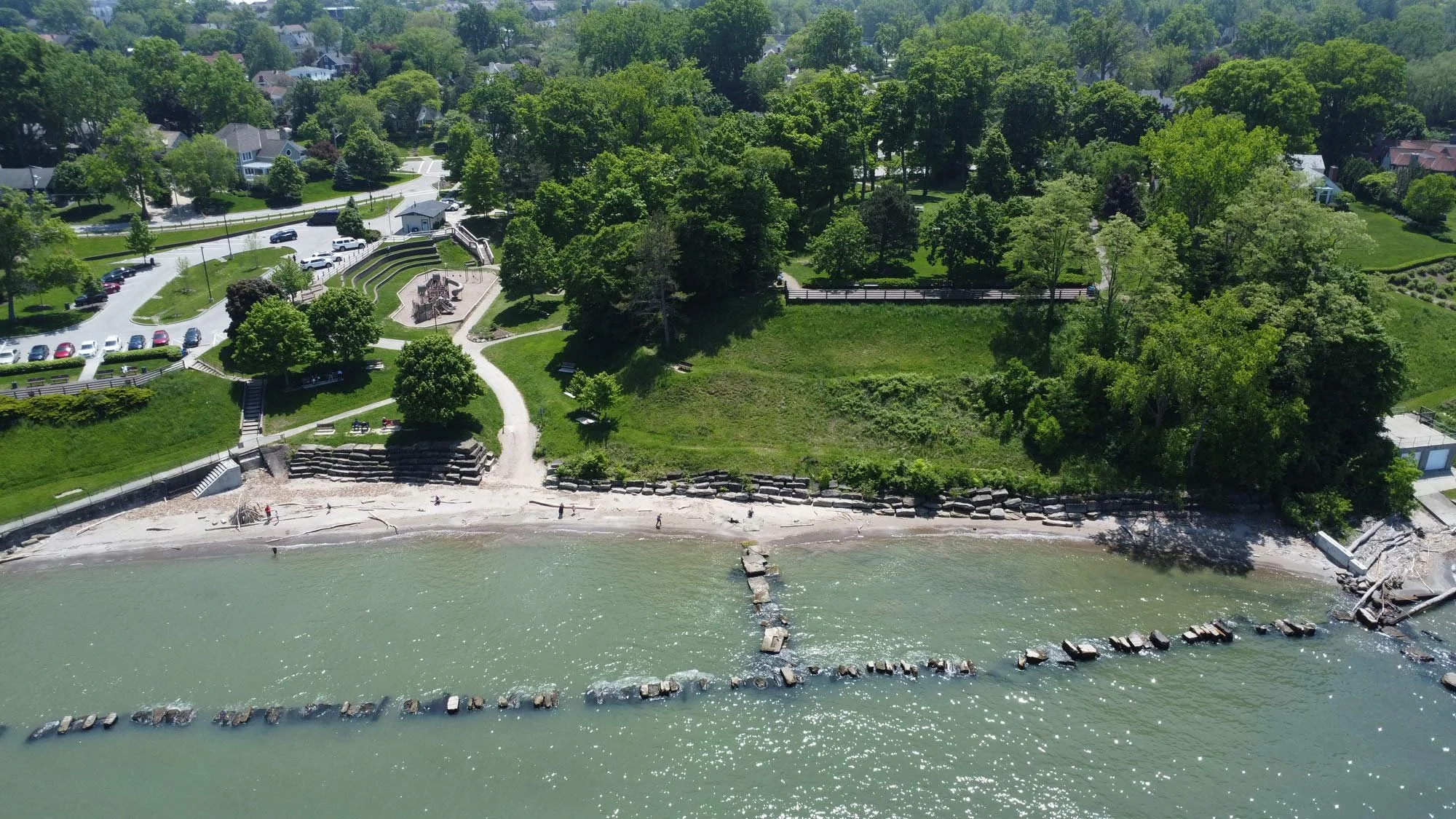
Rocky River is one of Cleveland's more affluent west-side suburbs, set along the Rocky River gorge and the Metroparks reservation that gives the city its name, with a compact business district along Detroit Road and Center Ridge Road rather than a downtown skyline. Companies headquartered here, financial services firms, medical practices, and professional offices near the Detroit Road corridor, exhibit at Cleveland's downtown venues regularly, but the drive is a genuine fifteen to twenty minutes rather than the near-immediate access Lakewood enjoys. The housing stock is older and larger than Lakewood's, and the commercial footprint smaller in proportion to the residential area around it.
We plan Rocky River shows around that slightly longer haul rather than pretending it does not exist. A booth staged from a Rocky River storage location needs a real transport window, typically via Detroit Road into the Shoreway, and we build that into the schedule instead of promising a downtown timeline that only works on paper.
The neighborhood itself is quieter and more residential than Lakewood, with fewer commercial loading zones and more single-family streets, which shapes how we stage vehicles and where we recommend meeting a crew before a downtown call time.
Rocky River, OH execution priorities
- Fifteen to twenty minute transport window into downtown
- Detroit Road and Shoreway routing for freight
- Storage staging for booths ahead of a downtown build
- Crew assembly and vehicle staging on residential streets
- Coordination with Westlake and Lakewood for shared crews
Rocky River's distance from the show floor, honestly
Rocky River is roughly fifteen to twenty minutes from Downtown Cleveland under normal traffic, further than Lakewood but noticeably closer than Westlake or the outer Lorain County suburbs. That places it in a middle zone: close enough that same-day booth changes are realistic, but far enough that we do not treat it as an extension of the downtown core the way we do with Lakewood.
Most Rocky River businesses we work with are financial, medical, or professional-services firms along Detroit Road and Center Ridge Road, exhibiting a handful of times a year at regional conventions rather than running a constant show calendar. That lower frequency means planning tends to start fresh for each show rather than drawing on a standing weekly routine.
Routing freight out of Rocky River
Detroit Road carries most of our traffic out of Rocky River toward downtown, feeding into the Shoreway for the final stretch to Huntington Convention Center or the arena district. We avoid Center Ridge Road for freight during school drop-off and pickup hours, since it runs slower through the business district at those times than Detroit Road does.
For larger booth builds, we schedule the freight departure with a buffer beyond the raw drive time, accounting for the merge onto the Shoreway and whatever event traffic downtown might already be building around a stadium or arena date. We also check the Detroit Road school-zone schedule before locking a departure window, since posted limits through the business district add real minutes during the school year that disappear entirely in summer.
Staging and storage before a downtown build
Several Rocky River clients keep exhibit components in storage locally between shows rather than routing them through a distant warehouse, which lets us stage a full pre-show inspection close to home before the transport window even opens. That inspection catches structural damage or missing hardware while there is still time to fix it, rather than discovering a problem at the loading dock.
We also use Rocky River storage as a staging point for shows that span multiple venues in a single week, moving partial loads out as each venue's dock window opens rather than holding everything for one large delivery.
Working on Rocky River's residential streets
Rocky River's business district is compact, and much of the surrounding area is single-family residential with limited commercial loading infrastructure. When a build calls for staging a larger vehicle overnight or assembling a crew before a downtown call time, we coordinate a specific meeting point near Detroit Road rather than defaulting to a residential street where a box truck would be out of place.
This is a smaller logistical detail than it sounds, but it matters for repeat clients: a crew that knows exactly where to stage before a 5 a.m. call time loses less time than one improvising a meeting spot each show.
Hotel and lodging options near Rocky River
Rocky River has limited hotel inventory of its own, mostly smaller independent properties, so out-of-town crew working a Rocky River-based build typically lodge downtown alongside the rest of the show team, at properties like the DoubleTree Lakeside or Embassy Suites Downtown, both of which sit close to the lakefront corridor Rocky River itself opens onto.
For local Rocky River staff, we avoid recommending a downtown hotel stay altogether when the show and the office are both reachable in the same day, since the drive does not usually justify the added cost.
Event types that suit Rocky River-based exhibitors
The professional-services and healthcare firms we work with in Rocky River tend toward mid-size convention booths, twenty-by-twenty or larger, rather than the smaller pop-up formats more common closer to the urban core. Their shows are usually planned months in advance rather than assembled quickly, which fits Rocky River's lower show frequency and gives us more lead time to work with.
We also see occasional client-hosted events at private venues along the lakefront, closer to a corporate off-site than a public trade show, which call for a different crew size and a lighter footprint than a full convention build.
Seasonal considerations along the lakeshore
Rocky River sits directly on Lake Erie, and winter lake-effect weather affects the corridor in the same way it affects Lakewood, sometimes worse given the more exposed stretches near the river mouth. Any build scheduled for a January or February morning gets extra transit time built in, particularly if the paths runs along the lakefront rather than inland.
Outside of winter, the calendar is straightforward, with spring and fall carrying the busiest regional show schedule and the least weather risk for a Rocky River departure.
Coordinating crews across nearby west-side suburbs
Rocky River sits between Lakewood and Westlake, and we frequently combine crew scheduling across all three when a show calls for more labor than one location can supply on short notice. A technician based near Rocky River can cover a Westlake call time or a Lakewood one without much added travel, which gives us more flexibility on last-minute staffing than treating each suburb as an isolated pool.
This shared-crew approach also helps with equipment: a specialized tool or fixture kept at a Rocky River storage site can move to a Westlake job the same morning rather than sitting unused. It also gives us backup coverage if a single technician calls off, since another crew member already familiar with the same venues is usually within a short drive.
How we plan a Rocky River-based show
We start by confirming the actual venue and its dock hours, then set the Rocky River departure time backward from that, building in the Detroit Road to Shoreway transit window rather than assuming a Lakewood-length drive. Storage, inspection, and crew staging all get scheduled around that departure time.
For repeat exhibitors, we keep a record of past transit times and any traffic patterns specific to their preferred venue, so each new show benefits from what we learned on the last one instead of starting from a generic estimate.
About Rocky River, OH
Rocky River, OH is one of the Cleveland area submarkets we cover for trade show work.
Rocky River, OH sits in the Inner west suburbs area.
Trade show work in Rocky River, OH shares most of its structure with larger Cleveland projects. Where it diverges is in the nearby venue mix, freight routing, and local hotel block availability.
Cleveland trade show market
Trade shows in Cleveland move fast. Major venues book out months in advance, freight windows run tight, and the exhibitors who win their weeks are the ones who arrive with a plan already in hand.
Exhibitors pulling back on budget in Cleveland still have to show up in the same booth neighborhoods as their competitors. Scope gets tighter; standards don't. The booths that land well are the ones built on a specific plan, not a standard layouts.
the market with roughly 24,000 hotel rooms across Northeast Ohio, about 5,000 rooms in 18 downtown hotels, 600 connected rooms at the convention-center campus, and roughly 3,000 rooms within five miles of Cleveland Hopkins International Airport.
Cleveland Hopkins International Airport reported more than 10 million annual passengers and 47 nonstop destinations, which materially supports exhibitor, crew, and attendee lift into the market, which sets the practical ceiling for a booth program working the market.
The advantage of a local Cleveland team
Trade Show Services of Cleveland keeps the work organized around one accountable project path. Booth design, fabrication coordination, graphics, venue communication, logistics, labor planning, show-site support, and closeout stay tied to the same brief.
Good execution depends on fewer blind handoffs. The person responsible for the plan should understand the room, the service orders, the graphics package, the install sequence, and the closeout path.
Repeat programs benefit when the plan captures what happened on the floor: what arrived late, what drew traffic, what took too long to assemble, and what should change before the next show.
Where Cleveland shows actually happen
The building matters more than almost anything else in a trade show plan. A few Cleveland venues carry most of the calendar.
The right building depends on the show: a consumer expo wants open aisles and broad traffic flow; a corporate conference wants controlled breakout space; a brand activation wants a venue that can carry scenic and production without fighting the architecture.
Rock & Roll Hall of Fame. It can host events for 20 to 2,000 people on its host-an-event section.
Who handles what during the Cleveland install window
Most of what goes wrong on a Cleveland install traces back to assumptions about labor. Staying inside the venue's published rules for the specific show prevents it.
On most Cleveland shows, the labor plan takes one call with the venue's exhibitor services desk, one review of the current manual, and one email to the general contractor. Skipping any of those three is usually where problems start.
At Huntington Convention Center of Cleveland, full-time employees of the exhibiting company or show management may set up computers, which is a narrow but important exception to more general labor assumptions.
Arena, stadium, and museum projects should be planned as venue-led operating environments with their own approvals and access rules. Final labor assumptions should always be confirmed against the current show manual, venue team, and general service contractor.
Line items on a typical project
Project scope usually spans design, fabrication, graphics, AV, labor coordination, freight, install, show-hours support, and strike.
What shows up in most budgets: structure, graphics, AV, show-service orders through the venue, labor, freight, supervision days, and closeout. Individual projects layer or remove items based on scope.
The handoffs on a project in Rocky River, OH Cleveland, OH matter almost as much as the line items. Design has to hand a build-ready drawing to fabrication. Fabrication has to hand a pre-built, dry-fitted booth to crating. The crater has to hand a labeled, manifested shipment to the carrier. Every handoff is a place quality can drop.
Multi-show programs add asset management: storage, refurbishment, graphic swaps, and scheduled re-kitting so the booth rolls cleanly from Cleveland to the next city on the calendar.
A clean scope definition also calls out what isn't included: show organizer fees, client staff travel, and anything the client already has under contract (lead capture platforms, CRM integrations, promotional giveaways). Those run alongside the engagement rather than inside it.
From first call to strike
Every project starts with a scope conversation: the show, the venue, the booth number, the dates, and the budget frame. Ten minutes of specifics produces a better plan than a week of generalities.
Once scope is clear, the venue work begins. Exhibitor manual, dock times, utility order IDs, rigging submissions for hanging elements, and labor calls all get locked against the venue's actual rules.
Production brings the plan into physical form: fabrication, graphics, AV, rentals, and the named lead who will run the floor.
One named show-site lead runs the install. Not a rotating crew and not a remote account manager — one person holds the floor plan, the punch list, and the labor calls from crates to doors.
Show-hours coverage is part of every engagement — not a premium add-on. On-floor support keeps the booth running while the client team runs the pipeline.
Closeout is tight: strike, crate, manifest, storage designation, and a written post-show report delivered within a day. That document drives the next booking.
Budget and timeline
An honest quote itemizes the variables. There is not a single price — there is a configuration.
Cost scales with how it is built, how big it is, what the venue charges for its own services, what the graphics look like, how far the crates travel, and how many days the team stays on-site.
On timing: custom builds for Cleveland shows run best with 16 to 20 weeks of lead time. Rental programs run on 8 to 12. Anything inside 4 weeks is a rush, which means fewer options and a premium on materials.
How project performance gets measured
A project runs well when install clears the venue's published window, all show services land as ordered, the booth performs across every show day without pulling the client team off pipeline work, and strike clears the dock before the next occupant loads in.
Trade show ROI is measured at the lead and pipeline level. The show-floor execution either protects or undermines those numbers.
The post-show debrief is where the numbers get connected back to the physical booth. Which demo station drew traffic, which meeting area closed more conversations, which graphic zone attracted dwell time — that feedback shapes the next build rather than getting lost.
Questions about Rocky River, OH
How far is Rocky River from Downtown Cleveland's venues?
About fifteen to twenty minutes under normal traffic via Detroit Road and the Shoreway, further than Lakewood but closer than Westlake or the outer Lorain County suburbs.
Can you store exhibit components locally between shows?
Yes. Several Rocky River clients keep booth components in local storage, which lets us run a pre-show inspection close to home and catch damaged or missing hardware before the transport window opens.
Where do you stage vehicles for a Rocky River build?
We coordinate a specific meeting point near Detroit Road rather than staging a box truck on a residential street, since much of the area around the business district is single-family housing without commercial loading infrastructure.
Where does out-of-town crew stay for a Rocky River-based show?
Typically downtown alongside the rest of the show team, at properties like the DoubleTree by Hilton Cleveland Downtown - Lakeside or Embassy Suites Downtown, both near the lakefront corridor Rocky River opens onto.
Do you combine crews between Rocky River, Lakewood, and Westlake?
We do when a show needs more labor than one location can supply on short notice. Technicians based near Rocky River can cover a Westlake or Lakewood call time without significant added travel.
What time of year adds risk to a Rocky River departure?
January and February, when lake-effect weather off Lake Erie hits the exposed stretches near the river mouth hardest. We add extra transit time for builds scheduled during that window.
Do you work at Rocket Arena?
Yes. Rocket Arena operates a 'Book Your Event' section, confirming private-event and hosted-event inventory. Projects at that building are planned against its specific floor rules.
How does labor work in Cleveland?
It runs venue by venue. At IATSE Local 27, it serves as a referral hall for many major theatres, arenas, and convention halls in Cleveland and specifically lists the Huntington Convention Center, Public Auditorium, and Rocket Arena among its venue and employer information. Other Cleveland venues have their own published rules, and the plan matches the specific building.
How much lead time is ideal?
Custom builds run best with 16 to 20 weeks of lead time. Rentals take 8 to 12 weeks. Work inside 4 weeks is possible but raises costs and narrows the options.
What information kicks off a project?
The show, the venue, the booth number, the dates, and a target budget range. From those, an initial scope and a realistic cost come back within a few days.
Who runs the booth on-site?
One named show-site lead runs the install, the show hours, and the strike. That person carries the floor plan and the punch list from crates to doors and reports up once a day.
Can the booth travel to the next city on our calendar?
Yes — builds are designed for modular reuse unless single-use scenic is specifically required. Same structure, swappable graphics, standard crates. Cleveland programs that roll to another city on the same calendar get handled end to end.
What happens if something breaks during show hours?
The show floor lead handles it. Minor repairs happen in place; anything larger gets sourced from the local fabricators or rerouted through the venue's service desk.