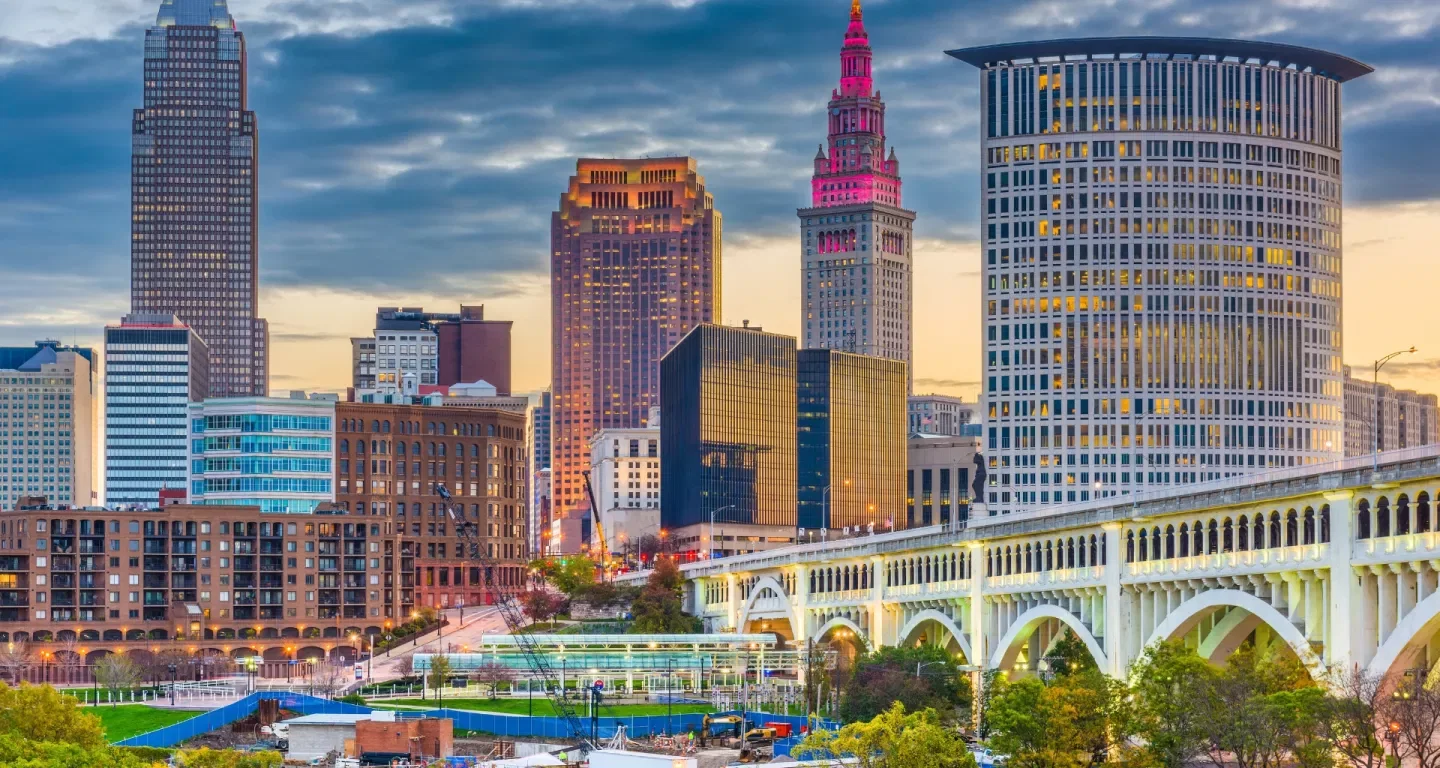
Cleveland carries more exhibit and event weight than any other market in northeast Ohio, and this page is written as the flagship view of that market rather than a single neighborhood inside it. Where our downtown, Public Square, Cleveland, Playhouse Square, Cleveland, East 4th Street, Cleveland, Warehouse District, Cleveland, and University Circle, Cleveland pages each zoom in on one pocket of the city, this page steps back and covers the whole metro: how shows move through the convention core, how the arena and stadium district handles large public events, and how freight actually gets from a dock to a show floor.
Most of the exhibit and trade show work in this city runs through the Huntington Convention Center of Cleveland, but it is not the only venue that matters. Rocket Arena and Progressive Field host branded activations and hospitality builds around games and concerts. The I-X Center handles the kind of oversized exposition freight that a downtown ballroom cannot. Museums along the lake and up in University Circle, Cleveland get booked for corporate galas, product reveals, and association dinners that need a different kind of build than a standard trade show booth.
This overview exists so a planner comparing Cleveland to other Ohio and Great Lakes markets can see the whole picture in one place: venue mix, hotel capacity, labor rules, freight access, and how our crews cover install and dismantle across all of it. From here, the individual neighborhood and venue pages go deeper on specifics like loading dock hours or union jurisdiction at a particular hall.
Cleveland, OH execution priorities
- Huntington Convention Center booth builds and floor logistics
- Rocket Arena and Progressive Field event and activation support
- I-X Center large-format exposition freight and install crews
- Downtown hotel and museum venue activations and brand experiences
- Drayage, advance freight, and warehouse coordination across the metro
Downtown convention core
The Huntington Convention Center of Cleveland is the anchor venue for exhibit and trade show work in this market. It sits below the Cleveland Convention Center Mall Plaza with direct connections to the Hilton Cleveland Downtown, and its below-grade exhibit halls give us predictable dock access and marshaling space that most downtown venues cannot match.
We run custom exhibit builds, modular systems, and full general contracting services out of this venue on a recurring basis. Because the show floor sits underground, rigging and power drops are planned early, and our project managers coordinate with the center's in-house engineering staff before trucks ever arrive.
The Huntington Convention Center also connects to Hilton's meeting space above it, letting a show spread breakout sessions and registration across two buildings without exhibitors losing sight of the main floor.
Arena and stadium district
Rocket Arena and Progressive Field sit within a few blocks of each other downtown and both get used for branded activations, sponsor villages, and hospitality builds tied to games, concerts, and one-off corporate events. This work looks different from a standard trade show floor: builds are often temporary, weather can be a factor at Progressive Field, and load-in windows are tighter because the venues still have to turn over for their primary sporting use.
For sponsorship activation buildouts and experiential brand activations in this district, our crews plan around game-day schedules and stadium operations staff rather than a fixed show calendar. That means more coordination up front on timing, but it also means access to some of the highest-visibility event real estate in the city.
I-X Center exposition hall
The I-X Center is the large-format answer for shows and expos that outgrow a downtown ballroom. Its massive open floor and drive-in dock access make it the right venue for consumer expos, boat and auto shows, and industrial exhibitions that involve heavy equipment or oversized freight.
Because the I-X Center is built for volume rather than boutique elegance, our drayage and material handling coordination there focuses on getting large numbers of trucks in and out on schedule and staging freight by hall section.
Downtown hotel and lodging capacity
Downtown Cleveland has a deep bench of hotel properties within walking distance of the Huntington Convention Center, including the Cleveland Marriott Downtown at Key Tower, Hilton Cleveland Downtown, Hilton Garden Inn Cleveland Downtown, Hotel Cleveland, Renaissance Cleveland Hotel, The Westin Cleveland Downtown, Embassy Suites by Hilton Cleveland Downtown, DoubleTree by Hilton Cleveland Downtown - Lakeside, and Hyatt Regency Cleveland at The Arcade.
That lodging density matters because it keeps hospitality suites, sponsor dinners, and overflow meeting space within a short walk of the main floor, which shapes how we schedule install crews around hotel checkout and event turnover.
Museum and cultural venue activations
Cleveland's museum district gives event planners a set of options that a standard hotel ballroom cannot replicate. The Rock & Roll Hall of Fame on the lakefront, the Great Lakes Science Center next door, and the Cleveland Museum of Art and Cleveland Museum of Natural History up in University Circle, Cleveland all book corporate galas, product launches, and association receptions.
These bookings call for a lighter footprint than a full trade show build, since the venues have their own collections and architecture to protect. Our lighting design for exhibits and product launch environments teams work within each museum's rules on rigging and after-hours access.
Drayage and freight logistics into the metro
Cleveland sits at a highway crossroads with I-90, I-71, I-77, and I-480 converging near downtown, which makes freight routing into the metro straightforward. Trucks headed to the Huntington Convention Center, the I-X Center, or a downtown hotel dock generally have a direct interstate approach.
Our expo logistics and shipping and drayage and material handling coordination teams track show-specific dock schedules at each venue, since the below-grade docks downtown and the drive-in bays at the I-X Center require different staging plans.
Labor and union considerations
Like most major convention markets, Cleveland venues operate under established labor agreements governing which trades handle electrical, rigging, and material handling on a show floor. Our trade show labor management and exhibitor appointed contractor coordination services keep exhibitors compliant while still getting their booth built on schedule.
Rules can differ between the Huntington Convention Center, the I-X Center, and privately operated venues like the arena or the museums, so we confirm jurisdiction before quoting install hours.
Warehouse and advance freight coordination
For exhibitors shipping ahead of a show, advance warehouse coordination lets freight arrive days or weeks before move-in, gets checked in and inventoried, then rolls to the show floor on a scheduled delivery window rather than competing with direct-to-show traffic.
This matters most for large builds headed to the Huntington Convention Center or the I-X Center, where dock capacity is tightest right before a show opens. We also handle exhibit storage and asset management for clients running a recurring program who do not want to ship a full booth home after every event.
Install, dismantle, and how this page fits the network
Our installation and dismantle crews cover every venue named on this page, from the Huntington Convention Center floor to arena concourses to museum galleries, and our show site supervision keeps a single point of contact on-site through move-in, show days, and teardown.
This page is intentionally broad because it serves as the starting point for the whole Cleveland metro rather than one address inside it. If you already know your show is at a specific downtown property, our Downtown Cleveland, Public Square, Cleveland, Playhouse Square, Cleveland, East 4th Street, Cleveland, Warehouse District, Cleveland, or University Circle, Cleveland pages go deeper on walking distances, nearby parking, and venue-specific access notes. We also cover the John S. Knight Center in nearby Akron for exhibitors running shows in both cities.
Cleveland, OH — what the area looks like for events
Cleveland, OH is one of the Cleveland area submarkets we cover for trade show work.
Cleveland, OH sits in the Primary city area.
Projects in Cleveland, OH get scoped the same way as work in the Cleveland core: venue, dates, footprint, and budget frame first, then the build plan. The difference is usually in freight routing and which nearby buildings are the closest fit.
The Cleveland event landscape
Cleveland is a working trade show market. Its anchor venues host hundreds of events a year, and the rhythm of load-in, show hours, and strike is well-established across the local vendor base.
The attendees vary by show — some weeks draw regional operators, others pull international buyers in for a single conference — but the floor mechanics stay consistent. Every booth needs graphics production, show services, labor calls, and a plan for the specific building it's landing in.
Cleveland Hopkins International Airport reported more than 10 million annual passengers and 47 nonstop destinations, which materially supports exhibitor, crew, and attendee lift into the market, which sets the practical ceiling for a booth program working the market.
Destination Cleveland’s winter 2025 meetings update says Hotel Cleveland reopened after a $90 million renovation with 491 rooms and 59,000 square feet of modernized meeting space, while Fidelity Hotel opened within walking distance of the convention center — a useful reference point when sizing a project.
Cleveland venues we work
Cleveland events cluster around a small number of venues, and each one has a different personality on the floor.
Across the Cleveland venue set, what changes between buildings are the labor model, the rigging approval path, the drayage setup, and the published move-in window. The plan has to match the specific building.
Huntington Convention Center of Cleveland is one of the anchors. Venue materials say the center provides over 520,000 square feet of meeting and event space.
Venue materials say the building includes 225,000 square feet of exhibit hall space, two ballrooms, and 50-plus breakout rooms.
Cleveland Public Auditorium. Cleveland Public Auditorium is directly connected to the Huntington Convention Center.
Hilton Cleveland Downtown: the property is a 600-room Hilton connected to the downtown campus.
Operational rules on the Cleveland floor
Cleveland floor operations follow the venue's own manual. Dock timing, utility orders, rigging, and crew calls all come out of that document.
The workable version of Cleveland labor planning is boring on purpose: read the manual, match the scope to its planning groups, order what the venue sells directly, and schedule everything else around its posted windows. Surprises almost always trace back to a step someone skipped.
Huntington Convention Center of Cleveland: Edlen Electric handles electrical and plumbing services on an exclusive basis, and the exhibitor services portal covers electrical, plumbing, air, water, internet, booth cleaning, catering, and rigging.
Practical planning rules for Cleveland, OH Cleveland, OH in Cleveland: Final labor assumptions should always be confirmed against the current show manual, venue team, and general service contractor. Cleveland labor requirements vary by venue, organizer, and current exhibitor manual.
What's included in the project scope
Projects in Cleveland, OH Cleveland, OH typically include design work, fabrication or rental sourcing, graphics production, show-service paperwork, freight, install, show-hours coverage, and strike.
Typical line items include booth structure (custom or rental), graphics and print, AV and lighting, show-service orders (power, internet, rigging), labor calls against the venue's rules, freight both ways, on-site supervision, and post-show closeout documentation.
Good execution comes from keeping the team small and the handoffs short. Every extra vendor in the chain adds a communication layer and a place where details get lost.
For programs that repeat, asset management becomes part of the engagement — storage, graphic rotation, refurbishment, and re-crating are planned rather than one-off.
Scope boundary is as important as scope inclusion. Show organizer fees, client-side staff costs, and any tools the client already owns are handled outside the engagement. Defining that boundary up front prevents billing surprises later.
What an engagement actually looks like
Every engagement begins the same way. The venue, the show dates, the footprint, and the target outcome go on the table first. From those four inputs, a real plan can be built.
Venue coordination comes next. That means pulling the current exhibitor manual, confirming dock and freight windows, submitting rigging approvals where needed, and placing utility orders against the building's published specs.
Production brings the plan into physical form: fabrication, graphics, AV, rentals, and the named lead who will run the floor.
Install days are owned by a single show floor lead. That person carries the plan, works the punch list in real time, and reports up once a day with real status.
During show hours, the booth functions as a live operating space. A booth supervisor manages repairs, sponsor requests, lead-capture issues, and any venue questions so client staff can focus on conversations.
Closeout is tight: strike, crate, manifest, storage designation, and a written post-show report delivered within a day. That document drives the next booking.
What it costs and how fast it moves
Pricing is driven by real line items: fabrication or rental, graphics, show services, labor, freight, and travel where it applies. Round numbers without that breakdown usually hide something.
Cost scales with how it is built, how big it is, what the venue charges for its own services, what the graphics look like, how far the crates travel, and how many days the team stays on-site.
Lead time drives everything. Custom: 16 to 20 weeks. Rental: 8 to 12. Under 4 weeks is possible but narrows choices and raises cost.
What a successful project looks like
A successful project in Cleveland looks like a booth that lands on time, passes venue inspection on the first walk, runs without incident through show hours, and ships out the same day it strikes.
Trade show ROI is measured at the lead and pipeline level. The show-floor execution either protects or undermines those numbers.
A week after the show, the booth's actual floor performance is already clearer than any pre-show projection. We document those observations alongside the technical closeout so the next cycle inherits real signal, not nostalgia.
How we're built to run your project
Trade Show Services of Cleveland is built for exhibitors that need practical trade show execution, not a disconnected list of vendors. The work is planned from the venue outward so the schedule, floor rules, freight path, and support plan stay connected.
The difference shows up before the dock opens. A clear project owner can confirm what the building requires, what the show organizer controls, which tasks belong to house services, and which decisions need client approval before the schedule gets tight.
Repeat programs benefit when the plan captures what happened on the floor: what arrived late, what drew traffic, what took too long to assemble, and what should change before the next show.
Questions about Cleveland, OH
What is the main convention venue in Cleveland?
The Huntington Convention Center of Cleveland is the primary exhibit hall for trade shows in this market. It sits below the convention center plaza downtown, connects to the Hilton Cleveland Downtown, and is where most of our custom exhibit builds and general contracting work happens.
Do you handle events at Rocket Arena or Progressive Field?
Yes. We build sponsor activations, hospitality suites, and branded environments at Rocket Arena and Progressive Field for games, concerts, and standalone corporate events. Scheduling around these venues works differently than a convention floor since they still have to turn over for sporting events.
When would a show use the I-X Center instead of downtown?
The I-X Center is the right choice for large consumer expos, auto and boat shows, and industrial exhibitions that need more open floor space and drive-in dock access than a downtown venue can offer. We handle drayage and freight staging there differently than at the Huntington Convention Center because of its scale.
Can you build activations at museums like the Rock & Roll Hall of Fame?
Yes. We have built product launches and corporate events at the Rock & Roll Hall of Fame, the Great Lakes Science Center, and the Cleveland Museum of Art and Cleveland Museum of Natural History in University Circle, Cleveland. These builds tend to be lighter footprint work that respects each venue's collections and facility rules.
How far is Downtown Cleveland lodging from the convention center?
Hotels like the Cleveland Marriott Downtown at Key Tower, Hilton Cleveland Downtown, Renaissance Cleveland Hotel, and Hyatt Regency Cleveland at The Arcade are all within a short walk of the Huntington Convention Center, which keeps exhibitor hospitality and overflow meeting space close to the main show floor.
Do you also cover Akron shows out of the same crew base?
Yes. Akron's John S. Knight Center is a regional sister venue we cover from the same crew base, though it is a separate building in Akron rather than part of Downtown Cleveland. Exhibitors running programs in both cities can use the same warehouse and labor coordination for consistency.
Do you work at Windows on the River?
Yes. it offers multiple event spaces inside the FirstEnergy Powerhouse with views of the skyline and Cuyahoga River. Projects at that building are planned against its specific floor rules.
How does labor work in Cleveland?
It runs venue by venue. At Huntington Convention Center of Cleveland, the convention center is a union facility and that certain union jurisdictions may apply based on the needs of the event. Other Cleveland venues have their own published rules, and the plan matches the specific building.
How much lead time is ideal?
Custom builds run best with 16 to 20 weeks of lead time. Rentals take 8 to 12 weeks. Work inside 4 weeks is possible but raises costs and narrows the options.
What information kicks off a project?
The show, the venue, the booth number, the dates, and a target budget range. From those, an initial scope and a realistic cost come back within a few days.
Who runs the booth on-site?
One named show-site lead runs the install, the show hours, and the strike. That person carries the floor plan and the punch list from crates to doors and reports up once a day.
Can the booth travel to the next city on our calendar?
Yes — builds are designed for modular reuse unless single-use scenic is specifically required. Same structure, swappable graphics, standard crates. Cleveland programs that roll to another city on the same calendar get handled end to end.
What happens if something breaks during show hours?
The show floor lead handles it. Minor repairs happen in place; anything larger gets sourced from the local fabricators or rerouted through the venue's service desk.