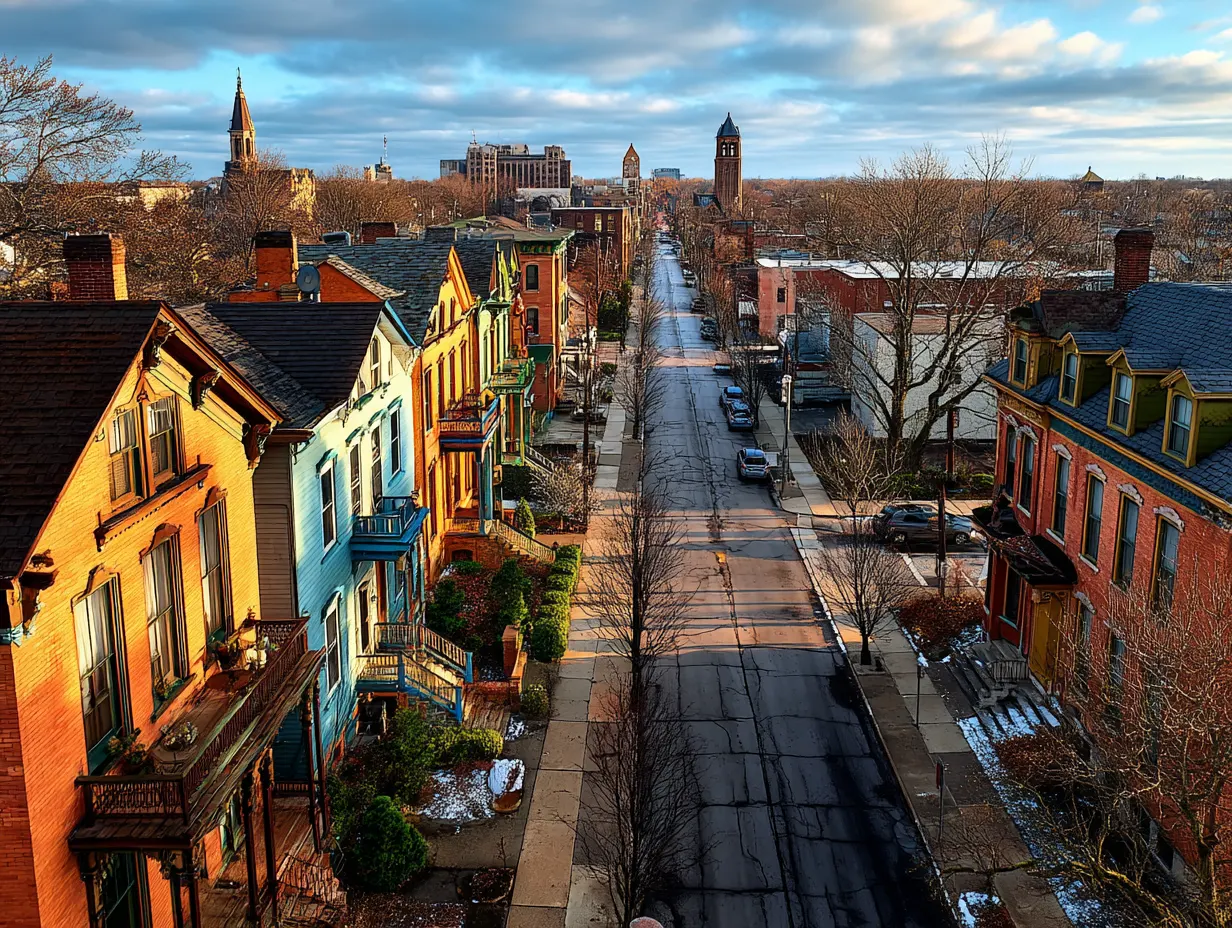
Parma is Cuyahoga County's largest suburb, a dense grid of single-family blocks, small manufacturers, and retail corridors along Ridge Road and State Road, sitting roughly ten to fifteen minutes south of Downtown Cleveland via I-71 or Broadview Road. Companies headquartered or exhibiting from Parma are almost never showing in Parma itself; the address matters for staging, warehousing, and crew dispatch, while the actual show sits at a downtown convention hall, stadium, or museum venue.
That distinction is the whole job. We treat Parma as a logistics origin point: a place to stage a truck, hold graphics overnight, or brief a install crew before they roll into downtown traffic patterns and loading-dock schedules that are nothing like a suburban business park. Getting a crate off a Parma dock at the wrong hour can mean missing a marshalling-yard window at Huntington Convention Center or the I-X Center, so timing gets built backward from the venue's dock schedule, not forward from when the truck happens to be loaded.
We have run programs for Parma-based manufacturers, distributors, and trade associations showing at Cleveland's downtown venues and at the I-X Center on the west side, and we know which paths avoids the worst of rush-hour backups on I-71 and I-480. Whether the show is a regional trade fair at a downtown hotel ballroom or a full general-session build at a convention center, the plan starts with where Parma actually sits relative to the floor, not with a boilerplate suburb pitch.
Parma, OH execution priorities
- Staging and dock coordination out of the Parma/Ridge Road corridor
- Routing crews and trucks around I-71 and I-480 peak congestion
- Drayage timed to Downtown Cleveland marshalling-yard windows
- Booth storage between Parma-area shows and Cleveland general sessions
- Labor call sheets that account for west-side commute realities
Where Parma sits relative to the Cleveland show floor
Parma runs along the west side of I-71 south of the inner ring, bordered by Cleveland to the north and Parma Heights and Seven Hills to the west and south. Nothing about the neighborhood is built for trade show traffic; it is rowhouses, strip retail, and light industrial parks. The nearest real show venues are downtown, roughly nine miles north, or the I-X Center further west near the airport.
For most Parma exhibitors that means a straightforward run up I-71 or Broadview Road into the Innerbelt, then a turn toward whichever venue the show is booked at. We plan the paths and the timing against actual traffic data for the show dates rather than assuming a flat drive time, because a Tuesday morning move-in during rush hour behaves very differently than a Saturday afternoon teardown.
Staging out of Parma before a downtown move-in
When a Parma company needs graphics printed, crated freight consolidated, or a booth pre-built before it ever reaches the show floor, we treat the suburb as a staging point rather than a destination. That can mean holding freight overnight at a local dock, running a dry-fit assembly in a warehouse bay, or timing a single consolidated truck run instead of several partial loads crossing the same paths.
This matters most for exhibitors who are new to Cleveland's downtown venues and underestimate how tight the loading-dock windows are at places like Huntington Convention Center or the I-X Center. A load that leaves Parma an hour late can miss its dock slot entirely and get pushed to the back of the marshalling queue.
Booth builds for Parma manufacturers and distributors
A number of light manufacturers and industrial distributors based in and around Parma exhibit regionally, often at trade fairs housed at the I-X Center or in downtown hotel ballrooms. For that audience we build modular systems that survive repeat use, since these exhibitors tend to return to the same regional circuit year after year rather than commissioning a one-off custom build.
Storage between shows is part of that plan. Rather than shipping a booth back to a manufacturer's facility after every event, we hold it in climate-controlled storage and stage it directly for the next Cleveland-area date, cutting both cost and handling risk.
Labor and crew logistics for the west side
Crew call times for a Parma-adjacent job account for the commute pattern into downtown, which differs from a crew based on the east side or in Lakewood. We schedule labor calls with enough buffer that a west-side crew isn't racing I-71 traffic to make a dock appointment, and we coordinate with venue labor rules so union jurisdiction and start times line up correctly regardless of where the crew physically starts its day.
Weather is part of that math too. A February move-in out of Parma can mean a slower Broadview Road commute or a closed lane on I-71, and a crew that leaves on a summer-schedule buffer during a winter show date risks a late dock arrival. We adjust call times seasonally rather than running the same buffer year-round.
Drayage timing against downtown dock windows
Every Downtown Cleveland venue runs its own marshalling-yard schedule, and missing a window from a Parma dock means sitting in a queue that can run hours behind. We build the drayage timeline backward from the venue's published dock schedule and work forward to a realistic Parma departure time, factoring in the specific bridge or interchange the truck will use that day.
For shows at Huntington Convention Center specifically, the marshalling yard fills fast during peak move-in hours, so a Parma truck scheduled for a mid-morning slot needs to leave earlier than a straight drive-time calculation would suggest. We track those specific patterns show by show rather than applying one generic rule to every date.
Working around the west side's freight realities
Parma's light-industrial parks are not set up for oversized trade show freight the way a purpose-built advance warehouse is. When a Parma company needs to consolidate several vendors' shipments into one load, we coordinate that through our own advance warehouse process rather than asking a local business to handle staging it was never designed for.
Regional shows versus one-off Cleveland appointments
Some Parma exhibitors show at the same one or two Cleveland-area venues every year; others are booking a single appointment show and need everything explained from scratch. We tailor the plan to which situation applies: a recurring exhibitor gets a repeatable playbook and stored assets, while a first-time exhibitor gets a fuller walkthrough of what downtown move-in actually looks like.
Coordinating with Parma facilities teams
For exhibitors with their own warehouse or office space in Parma, we work directly with in-house facilities staff to schedule dock access, confirm loading equipment, and set a realistic timeline that respects both the show's requirements and the exhibitor's own building rules, rather than treating the local facility as an afterthought.
What a typical Parma-origin program looks like
A standard engagement starts with a site check of the Parma dock or storage location, followed by a drayage and routing plan tied to the specific venue and show dates, a labor call sheet built for the actual crew's commute, and a post-show storage or return plan so the exhibitor isn't scrambling to figure out what happens to the booth once the show closes.
About Parma, OH
Parma, OH falls inside the Cleveland service footprint for trade show projects.
Parma, OH sits in the Southwest suburbs area.
Projects in Parma, OH get scoped the same way as work in the Cleveland core: venue, dates, footprint, and budget frame first, then the build plan. The difference is usually in freight routing and which nearby buildings are the closest fit.
Cleveland as a trade show city
Trade shows in Cleveland move fast. Major venues book out months in advance, freight windows run tight, and the exhibitors who win their weeks are the ones who arrive with a plan already in hand.
Trade show weeks in Cleveland compress decisions. Dock windows are finite, rigging slots fill fast, and the labor calendar around a citywide conference runs hot. Exhibitors who treat planning as optional lose time they don't get back.
Destination Cleveland’s winter 2025 meetings update says Hotel Cleveland reopened after a $90 million renovation with 491 rooms and 59,000 square feet of modernized meeting space, while Fidelity Hotel opened within walking distance of the convention center.
Destination Cleveland’s winter 2025 update says the Cleveland Museum of Natural History reopened more than 375,000 square feet of transformed space in late 2024 and that the Rock & Roll Hall of Fame expansion is creating a new 2,800-person indoor event venue — a useful reference point when sizing a project.
Cleveland convention venues and meeting properties
Every Cleveland show takes place in a specific building with its own rules. The venues below are common planning anchors across the local event calendar.
A venue walk — either in person or via the published floor plan — is the step that reveals constraints no spec sheet shows. Column spacing, real ceiling height at the grid point, and dock access shape what's actually buildable.
Rock & Roll Hall of Fame: it can host events for 20 to 2,000 people on its host-an-event section.
From early 2025 through mid-2026 it will not host events larger than 800 during expansion work.
Cleveland Museum of Natural History is one of the anchors. The museum completed a $150 million transformation and reopened more than 375,000 square feet of reimagined space in December 2024.
Cleveland labor and venue services
There is no single labor model for Cleveland trade shows. The right approach depends on the specific venue and the show organizer's contracts.
Practically, that means pulling the current exhibitor manual for every show and confirming a handful of items in writing: which tasks the venue's house crews cover, which tasks the show's general contractor covers, and what an exhibitor or their appointed contractor can handle without escalation.
At IATSE Local 27, it serves as a referral hall for many major theatres, arenas, and convention halls in Cleveland and specifically lists the Huntington Convention Center, Public Auditorium, and Rocket Arena among its venue and employer information.
Final labor assumptions should always be confirmed against the current show manual, venue team, and general service contractor. Cleveland labor requirements vary by venue, organizer, and current exhibitor manual.
Scope in Parma, OH Cleveland, OH
A full engagement covers scope development, fabrication or rental, graphics, show services, logistics, and on-site execution from move-in through dismantle.
What shows up in most budgets: structure, graphics, AV, show-service orders through the venue, labor, freight, supervision days, and closeout. Individual projects layer or remove items based on scope.
A well-run project has few surprises on install day because the handoffs upstream were tight. A bad one has many, because they weren't.
Multi-show programs add asset management: storage, refurbishment, graphic swaps, and scheduled re-kitting so the booth rolls cleanly from Cleveland to the next city on the calendar.
Out of scope by default are show organizer fees, booth lease costs paid directly to the show, staff travel and per diems, and any custom software or data-capture tooling the client runs on its own stack. Those stay on the client side and plug into the project through coordination, not rebilling.
The process from start to finish
Every project starts with a scope conversation: the show, the venue, the booth number, the dates, and the budget frame. Ten minutes of specifics produces a better plan than a week of generalities.
Once scope is clear, the venue work begins. Exhibitor manual, dock times, utility order IDs, rigging submissions for hanging elements, and labor calls all get locked against the venue's actual rules.
Production brings the plan into physical form: fabrication, graphics, AV, rentals, and the named lead who will run the floor.
One named show-site lead runs the install. Not a rotating crew and not a remote account manager — one person holds the floor plan, the punch list, and the labor calls from crates to doors.
Show-hours coverage is part of every engagement — not a premium add-on. On-floor support keeps the booth running while the client team runs the pipeline.
Closeout is tight: strike, crate, manifest, storage designation, and a written post-show report delivered within a day. That document drives the next booking.
Cost and lead time
An honest quote itemizes the variables. There is not a single price — there is a configuration.
Cost scales with how it is built, how big it is, what the venue charges for its own services, what the graphics look like, how far the crates travel, and how many days the team stays on-site.
On timing: custom builds for Cleveland shows run best with 16 to 20 weeks of lead time. Rental programs run on 8 to 12. Anything inside 4 weeks is a rush, which means fewer options and a premium on materials.
What a successful project looks like
A project runs well when install clears the venue's published window, all show services land as ordered, the booth performs across every show day without pulling the client team off pipeline work, and strike clears the dock before the next occupant loads in.
Trade show ROI is measured at the lead and pipeline level. The show-floor execution either protects or undermines those numbers.
The post-show debrief is where the numbers get connected back to the physical booth. Which demo station drew traffic, which meeting area closed more conversations, which graphic zone attracted dwell time — that feedback shapes the next build rather than getting lost.
Why Trade Show Services of Cleveland
Trade Show Services of Cleveland keeps the work organized around one accountable project path. Booth design, fabrication coordination, graphics, venue communication, logistics, labor planning, show-site support, and closeout stay tied to the same brief.
Good execution depends on fewer blind handoffs. The person responsible for the plan should understand the room, the service orders, the graphics package, the install sequence, and the closeout path.
Repeat programs benefit when the plan captures what happened on the floor: what arrived late, what drew traffic, what took too long to assemble, and what should change before the next show.
Questions about Parma, OH
Do you handle shows staged at venues near Parma, or only Downtown Cleveland?
Parma itself doesn't host trade show venues; the real show floors are downtown or at the I-X Center to the west. We treat Parma as a staging and logistics origin point and paths freight and crews to whichever venue the show is actually booked at.
How far is Parma from Cleveland's downtown convention venues?
It is roughly nine to eleven miles, about ten to twenty minutes depending on traffic and the exact paths via I-71, Broadview Road, or the Innerbelt. We build timing against the actual show dates rather than a flat average, since rush-hour conditions change the math.
Can you store a booth in the Parma area between shows?
Yes. We hold booths and graphics in climate-controlled storage and stage them for the next Cleveland-area date rather than shipping equipment back to a manufacturer's facility after every appointment, which keeps handling and cost down for exhibitors who show regionally.
What venue is closest to Parma for a west-side show?
The I-X Center, further west near Cleveland Hopkins Airport, is generally the closer option compared to downtown venues, though the exact best routing depends on which interchange and time of day the crew will be traveling.
Do you work with Parma-based manufacturers who exhibit only occasionally?
Yes, and that is a common profile in the area. We build modular systems designed for infrequent use and storage rather than a full custom build meant for a single show, which keeps ongoing costs manageable for exhibitors who only show once or twice a year.
Can you coordinate a single consolidated truck from a Parma facility?
Yes. When a Parma company has multiple vendors or components arriving separately, we consolidate them into one load out of the local facility so the drayage crew at the venue only has to manage a single truck against its dock window.
Do you work at Rocket Arena?
Yes. Rocket Arena operates a 'Book Your Event' section, confirming private-event and hosted-event inventory. Projects at that building are planned against its specific floor rules.
How does labor work in Cleveland?
It runs venue by venue. At Huntington Convention Center of Cleveland, full-time employees of the exhibiting company or show management may set up computers, which is a narrow but important exception to more general labor assumptions. Other Cleveland venues have their own published rules, and the plan matches the specific building.
How much lead time is ideal?
Custom builds run best with 16 to 20 weeks of lead time. Rentals take 8 to 12 weeks. Work inside 4 weeks is possible but raises costs and narrows the options.
What information kicks off a project?
The show, the venue, the booth number, the dates, and a target budget range. From those, an initial scope and a realistic cost come back within a few days.
Who runs the booth on-site?
One named show-site lead runs the install, the show hours, and the strike. That person carries the floor plan and the punch list from crates to doors and reports up once a day.
Can the booth travel to the next city on our calendar?
Yes — builds are designed for modular reuse unless single-use scenic is specifically required. Same structure, swappable graphics, standard crates. Cleveland programs that roll to another city on the same calendar get handled end to end.
What happens if something breaks during show hours?
The show floor lead handles it. Minor repairs happen in place; anything larger gets sourced from the local fabricators or rerouted through the venue's service desk.