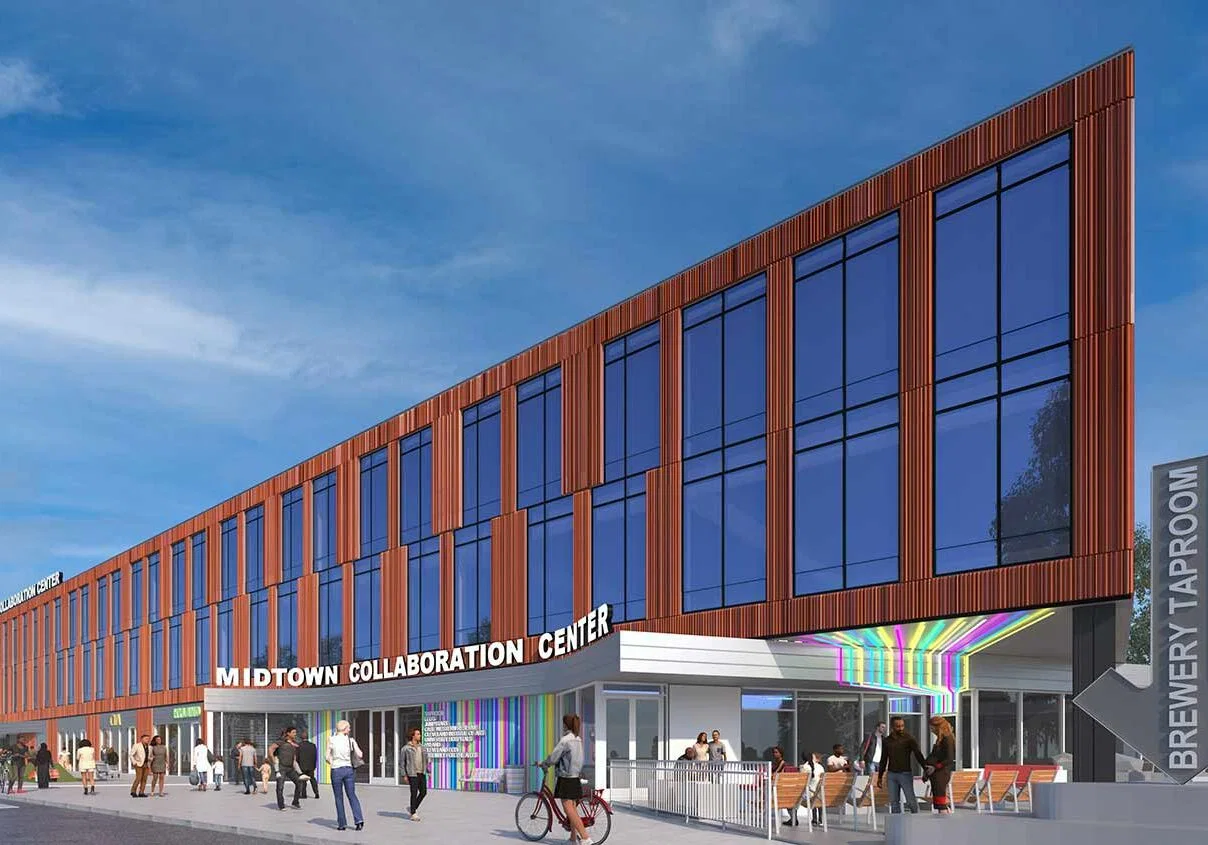
Midtown Cleveland runs along Euclid Avenue and Chester Avenue from roughly East 22nd Street out to East 79th, a strip of converted machine shops and newer lab buildings that now house biomedical startups, health-tech firms, and light manufacturers. MAGNET and several bioscience tenants anchor the corridor, and companies here are more likely to be building a product than booking a booth. It is a working district, not a venue district, and a client based here needing exhibit support is describing an event happening elsewhere, or an activation inside their own building.
Trade Show Services of Cleveland treats Midtown as an origin point rather than a destination. A biotech firm exhibiting at a regional conference downtown, a manufacturer hosting a showroom open house in its own converted warehouse, or a startup running a product demo for investors all fall under the same model: crew, freight, and fabrication stage from our downtown-adjacent operation and go wherever the audience is.
This page covers production and logistics when the client's address is Midtown, whether the work happens inside that building or across town at Huntington Convention Center. It is narrower than our Downtown Cleveland coverage, which handles the convention center and hotel-ballroom side directly.
Midtown Cleveland, OH execution priorities
- Private showroom and open-house builds inside Midtown lab and light-industrial buildings
- Freight coordination for converted buildings with limited docks and narrow floor plates
- Staging exhibitor freight and crew from downtown for Midtown-based companies showing elsewhere
- Small-crew install and dismantle for product demos and investor showcases
- Advance warehouse handling that bridges Midtown clients to convention-floor timelines
A biotech and maker corridor, not a show district
Euclid Avenue through Midtown was industrial before it was biomedical, and the building stock still shows it: single-story machine shops, mid-rise manufacturing floors, and newer lab construction serving the health-tech and bioscience tenants that have moved in over the past decade. MAGNET's presence reflects that shift toward advanced manufacturing rather than hospitality or assembly.
None of that building stock was designed to hold a trade show. There is no exhibit hall, no loading configuration for a queue of drayage trucks, and no meeting-planner infrastructure. Companies here build products; when they need to present them to buyers or investors, the room usually has to be assembled for that purpose, a fabrication job rather than a venue-booking job.
Why Midtown has no dedicated show venue
Cleveland's exhibit infrastructure is concentrated downtown around Huntington Convention Center, which has the loading docks, floor load capacity, and hall configuration a full trade show requires. Midtown never developed that infrastructure because its real estate history ran toward manufacturing, and now toward lab conversion.
That absence is not a coverage gap. It is geography: exhibitors converge downtown, and Midtown functions as an adjacent corridor whose companies participate without hosting. We plan around that reality rather than pretending a venue exists where it does not.
Private showrooms and open-house events inside Midtown buildings
The activity that does happen physically in Midtown tends to be smaller and more targeted than a public trade show: a biomedical device company opening its lab floor to investors, a manufacturer converting part of its shop into a temporary showroom, or a startup running a demo day in its own leased space.
These jobs still need real production: custom exhibit builds sized to an existing floor plate, portable display systems set up and struck in a single day, lighting suited to an industrial ceiling rather than a hall grid, and a registration and planning topic environment at whatever door the building has. The scope is smaller than a convention floor, but the craft is the same.
Freight access in converted industrial buildings
Converted Midtown buildings vary widely in how they handle freight. Some retain a working loading dock from their manufacturing days; others were subdivided for lab and office tenants and now have only a freight elevator or a street-level door. Floor plates also tend to be narrower and more column-heavy than a purpose-built hall, limiting how large a build element can be moved in one piece.
We survey the building before committing to a build plan rather than assuming dock access, which drives decisions on modular systems versus larger custom fabrication, whether components get pre-assembled offsite, and crew size for a manual carry-in when a freight elevator is the only path.
University Circle, Cleveland proximity for adjacent activations
Midtown sits directly west of University Circle, Cleveland, and companies based here occasionally look east rather than downtown for an activation venue. Cleveland Museum of Art, Cleveland Museum of Natural History, and the lakefront pairing of Great Lakes Science Center and Rock & Roll Hall of Fame all host private events on occasion, a short trip from Midtown.
We treat those as occasional, client-driven choices rather than standing Midtown coverage. When a client wants a launch event staged at a University Circle, Cleveland museum instead of their own building, the plan shifts toward experiential brand activation and sponsorship activation buildouts suited to that venue's floor and access rules.
Coordinating with Huntington Convention Center for Midtown-headquartered exhibitors
The more common request from a Midtown company is not an event in Midtown at all, but exhibitor support for a show at Huntington Convention Center. A biomedical firm on Euclid Avenue exhibiting at a health-sciences conference needs the same drayage, booth design, and install-and-dismantle work any downtown exhibitor needs.
The Midtown address mainly matters for where advance freight originates. Production planning, exhibitor-appointed contractor coordination, and show-site supervision paths through our downtown operation regardless of where the office sits.
Advance freight and warehouse staging for the corridor
Companies based in Midtown that exhibit regularly benefit from advance warehouse coordination rather than shipping directly to a show site on move-in day. Freight can be received, inventoried, and held ahead of a show, then delivered to Huntington Convention Center on a scheduled dock appointment instead of competing with every exhibitor's truck that morning.
The same model applies to Midtown's own building constraints: when a location has a narrow dock window or none at all, we hold graphics and hardware at our warehouse and deliver on a tighter schedule. For companies that show repeatedly, this also feeds exhibit storage and asset management between events.
Crew sizing for private events versus full trade shows
A Midtown open house or investor demo day rarely calls for the same install crew as a convention-floor booth. Labor is typically a small, generalist team handling carpentry, AV, and graphics in a single pass, rather than the specialized union planning groups a large hall requires under exhibitor-appointed contractor rules.
A private Midtown build can often go up and come down the same day, where a convention center booth follows a multi-day move-in and move-out calendar set by the hall's general contractor. Trade show labor management and project management still apply to both, but crew size, timeline, and union rules differ enough that we plan them as distinct job types.
How this page differs from Downtown Cleveland
Our Downtown Cleveland coverage handles Huntington Convention Center and the hotel-ballroom event market directly: full trade shows, general contracting, and the drayage volume a hall full of exhibitors brings. This Midtown page exists for companies along the Euclid Avenue corridor who need either a private on-site build or help getting an exhibit to a venue elsewhere.
If your event is at the convention center itself, start from our Downtown Cleveland page. If your team is based in Midtown and needs a showroom built inside your own building, or freight staged from a facility that understands the corridor's dock limitations, this is the right starting point.
Trade show work in Midtown Cleveland, OH
Midtown Cleveland, OH falls inside the Cleveland service footprint for trade show projects.
Midtown Cleveland, OH sits in the Institutional east side area.
Projects in Midtown Cleveland, OH get scoped the same way as work in the Cleveland core: venue, dates, footprint, and budget frame first, then the build plan. The difference is usually in freight routing and which nearby buildings are the closest fit.
Who handles what during the Cleveland install window
There is no single labor model for Cleveland trade shows. The right approach depends on the specific venue and the show organizer's contracts.
On most Cleveland shows, the labor plan takes one call with the venue's exhibitor services desk, one review of the current manual, and one email to the general contractor. Skipping any of those three is usually where problems start.
At Huntington Convention Center of Cleveland, full-time employees of the exhibiting company or show management may set up computers, which is a narrow but important exception to more general labor assumptions.
Final labor assumptions should always be confirmed against the current show manual, venue team, and general service contractor. Cleveland labor requirements vary by venue, organizer, and current exhibitor manual.
Where Cleveland shows actually happen
Every Cleveland show takes place in a specific building with its own rules. The venues below are common planning anchors across the local event calendar.
Across the Cleveland venue set, what changes between buildings are the labor model, the rigging approval path, the drayage setup, and the published move-in window. The plan has to match the specific building.
Rock & Roll Hall of Fame is one of the anchors. It can host events for 20 to 2,000 people on its host-an-event section.
Cleveland trade show market
Trade shows in Cleveland move fast. Major venues book out months in advance, freight windows run tight, and the exhibitors who win their weeks are the ones who arrive with a plan already in hand.
Exhibitors pulling back on budget in Cleveland still have to show up in the same booth neighborhoods as their competitors. Scope gets tighter; standards don't. The booths that land well are the ones built on a specific plan, not a standard layouts.
the market with roughly 24,000 hotel rooms across Northeast Ohio, about 5,000 rooms in 18 downtown hotels, 600 connected rooms at the convention-center campus, and roughly 3,000 rooms within five miles of Cleveland Hopkins International Airport — a useful reference point when sizing a project.
Cleveland Hopkins International Airport reported more than 10 million annual passengers and 47 nonstop destinations, which materially supports exhibitor, crew, and attendee lift into the market.
Line items on a typical project
A full engagement covers scope development, fabrication or rental, graphics, show services, logistics, and on-site execution from move-in through dismantle.
What shows up in most budgets: structure, graphics, AV, show-service orders through the venue, labor, freight, supervision days, and closeout. Individual projects layer or remove items based on scope.
Good execution comes from keeping the team small and the handoffs short. Every extra vendor in the chain adds a communication layer and a place where details get lost.
Multi-show programs add asset management: storage, refurbishment, graphic swaps, and scheduled re-kitting so the booth rolls cleanly from Cleveland to the next city on the calendar.
Out of scope by default are show organizer fees, booth lease costs paid directly to the show, staff travel and per diems, and any custom software or data-capture tooling the client runs on its own stack. Those stay on the client side and plug into the project through coordination, not rebilling.
From first call to strike
Every engagement begins the same way. The venue, the show dates, the footprint, and the target outcome go on the table first. From those four inputs, a real plan can be built.
After the brief, the work turns to the building itself. Dock windows, utility orders, rigging approvals, and labor calls are all confirmed in writing before anything goes to fabrication.
Production covers fabrication, graphics, AV spec, rentals, and crew chief assignment. It is the longest phase of most projects and the one where timelines are either protected or lost.
Install days are owned by a single show floor lead. That person carries the plan, works the punch list in real time, and reports up once a day with real status.
Throughout show hours, the show floor lead stays present. Tech breaks, sponsor changes, venue requests — all handled without pulling the client team off the floor.
Strike and closeout happen the same day. Storage labels, outbound manifests, vendor performance notes, and a written debrief go out within 24 hours of doors closing.
Budget and timeline
Every project has the same cost drivers. The number depends on scope, and scope depends on a handful of specific variables.
Six variables drive the cost: custom versus rental, booth footprint and complexity, venue-specific labor and rigging fees, graphics scope and substrate, freight distance and timing, and the number of on-site supervision days.
Lead time drives everything. Custom: 16 to 20 weeks. Rental: 8 to 12. Under 4 weeks is possible but narrows choices and raises cost.
What a successful project looks like
The measure of a good engagement is simple: on-time install, no venue callouts, clean show hours, and a closeout that makes the next event easier to book.
Most programs in Cleveland are evaluated on lead-capture volume, meetings booked on the floor, and qualified-pipeline attribution after the show. The booth is a means to those numbers — it is not the number itself.
A week after the show, the booth's actual floor performance is already clearer than any pre-show projection. We document those observations alongside the technical closeout so the next cycle inherits real signal, not nostalgia.
The advantage of a local Cleveland team
Trade Show Services of Cleveland is built for exhibitors that need practical trade show execution, not a disconnected list of vendors. The work is planned from the venue outward so the schedule, floor rules, freight path, and support plan stay connected.
The value is coordination under pressure. If a graphics issue, freight delay, or venue question appears during install, the response has to be fast, documented, and connected to the actual show plan.
Consistency across show dates matters because many exhibitors reuse decisions, graphics, crates, and layouts across multiple venues. A documented plan helps the next event start from what was learned instead of starting over.
Questions about Midtown Cleveland, OH
Is there a convention center or exhibit hall in Midtown Cleveland
No. Midtown has no dedicated convention center, exhibit hall, or arena. It is a biotech and light-industrial corridor between downtown and University Circle, Cleveland. Exhibitors converge at Huntington Convention Center downtown, and any full trade show involving a Midtown-based company is staged there, not in Midtown.
Can you build a private showroom or open-house display inside our Midtown building
Yes. We build small custom exhibits, portable display systems, and lighting setups sized to a specific floor plate inside converted lab and light-industrial buildings. We survey dock and elevator access first, since converted Midtown spaces vary widely in how freight moves in and out.
We are headquartered in Midtown but exhibiting at a show downtown, do you cover that
Yes, and it is the more common request from Midtown-based clients. Advance freight staging, drayage, booth design, and installation and dismantle paths through our downtown operation regardless of where your office sits. Your Midtown address mainly determines where advance freight originates and how we schedule pickup.
Do you ever stage events at University Circle, Cleveland museums for Midtown clients
Occasionally, when a client specifically wants that setting. Cleveland Museum of Art, Cleveland Museum of Natural History, Great Lakes Science Center, and Rock & Roll Hall of Fame sit a short trip east of Midtown and sometimes host private brand activations. It is a client-driven choice, not a standing part of our Midtown coverage.
How does freight access work in older Midtown buildings
It depends on the building. Some retain a working loading dock from their manufacturing history, while others were subdivided into lab and office space and now have only a freight elevator or street-level door. We survey the building before finalizing a build plan and size components and crew to what it can actually move.
What is the difference between this page and your Downtown Cleveland page
Downtown Cleveland covers Huntington Convention Center and hotel-ballroom events directly, including full trade show general contracting and conference execution. This Midtown page covers companies along the Euclid Avenue corridor who need a private on-site build or help getting exhibits to a venue elsewhere. Start with whichever page matches where the event is actually happening.
Do you work at John S. Knight Center?
Yes. the center offers 123,000 square feet of customizable space. Projects at that building are planned against its specific floor rules.
How does labor work in Cleveland?
It runs venue by venue. At IATSE Local 27, it serves as a referral hall for many major theatres, arenas, and convention halls in Cleveland and specifically lists the Huntington Convention Center, Public Auditorium, and Rocket Arena among its venue and employer information. Other Cleveland venues have their own published rules, and the plan matches the specific building.
How much lead time is ideal?
Custom builds run best with 16 to 20 weeks of lead time. Rentals take 8 to 12 weeks. Work inside 4 weeks is possible but raises costs and narrows the options.
What information kicks off a project?
The show, the venue, the booth number, the dates, and a target budget range. From those, an initial scope and a realistic cost come back within a few days.
Who runs the booth on-site?
One named show-site lead runs the install, the show hours, and the strike. That person carries the floor plan and the punch list from crates to doors and reports up once a day.
Can the booth travel to the next city on our calendar?
Yes — builds are designed for modular reuse unless single-use scenic is specifically required. Same structure, swappable graphics, standard crates. Cleveland programs that roll to another city on the same calendar get handled end to end.
What happens if something breaks during show hours?
The show floor lead handles it. Minor repairs happen in place; anything larger gets sourced from the local fabricators or rerouted through the venue's service desk.