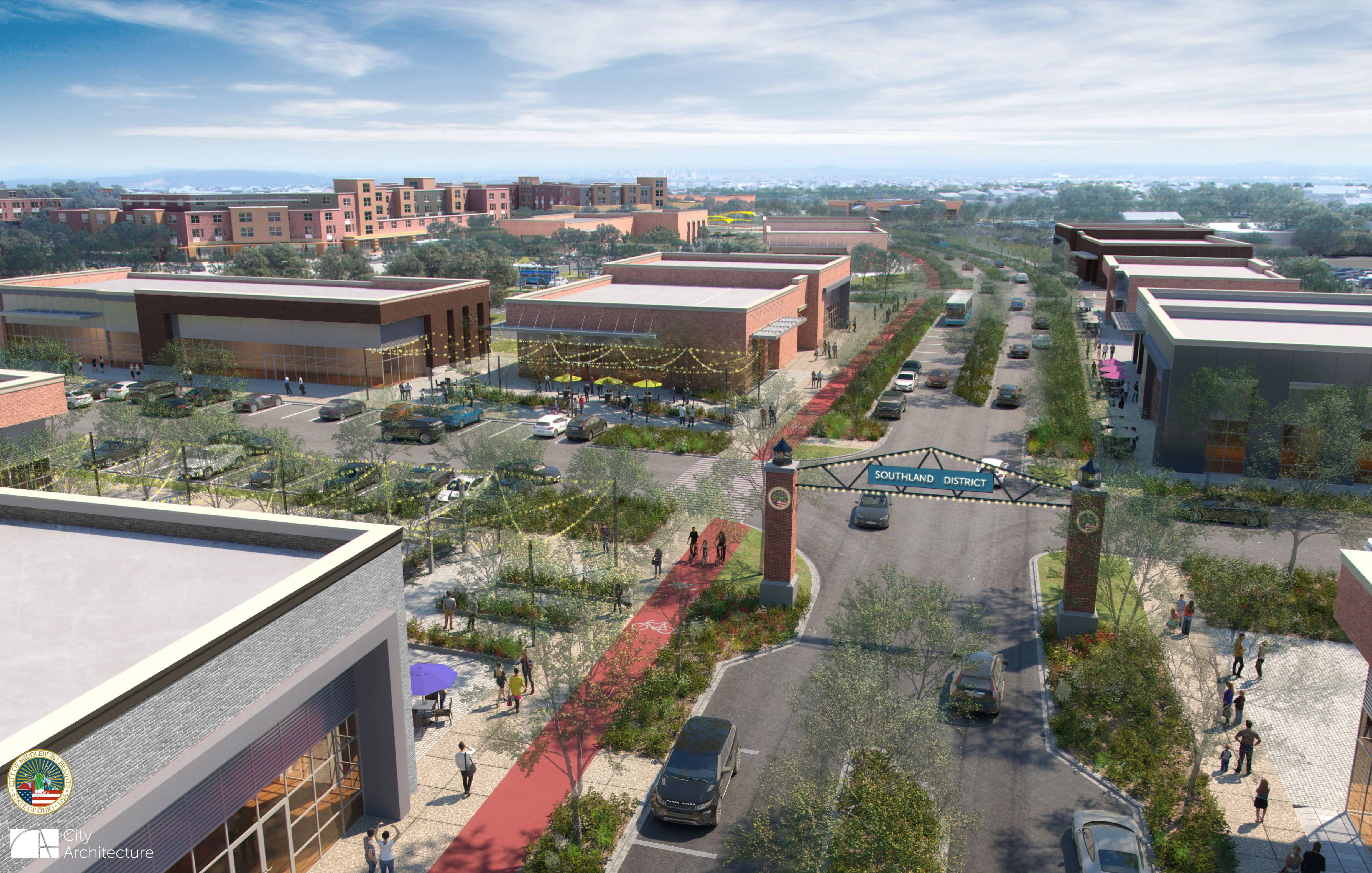
Middleburg Heights is a west-side suburb built up along Bagley Road and Pearl Road, immediately south and west of Brook Park and only a few minutes from the airport corridor. Its business base leans toward retail, medical offices, and light commercial space rather than heavy industry, but its location matters more than its own footprint: it sits closer to the I-X Center than almost anywhere in the metro outside Brook Park itself.
For a Middleburg Heights exhibitor, the trip to a west-side show is short and simple, usually a straight shot down Bagley Road or a quick hop on I-71 or I-480 to the airport interchange. That changes the calculus for warehousing and drayage: freight staged here doesn't need the long buffer a downtown-bound Parma or Solon shipment does, because the I-X Center is close enough to treat almost like a same-neighborhood delivery.
Downtown Cleveland shows are a different story. Middleburg Heights sits roughly fifteen miles from the downtown venues, and we plan those trips with the same care as any other west-side origin point, factoring in I-71 congestion and the specific downtown dock window a show requires.
Middleburg Heights, OH execution priorities
- Short-haul drayage from Middleburg Heights into the I-X Center
- Freight staging that takes advantage of the airport-corridor proximity
- Downtown routing via I-71 for shows away from the west side
- Crew scheduling that accounts for Bagley Road and Pearl Road access
- Booth storage positioned for repeat I-X Center exhibitors
Why Middleburg Heights is a west-side logistics advantage
The suburb's location next to Brook Park puts it inside a tight radius of the I-X Center, closer than most of the rest of the metro. Exhibitors based here who show at I-X Center events benefit from shorter drayage runs, less exposure to interstate congestion, and more flexibility on departure times than a company staging from downtown or the east side.
That proximity doesn't extend to downtown venues, though, and we're careful not to let a client assume every Cleveland show is a short trip just because the last one at I-X Center was.
We map out both scenarios at the start of a relationship with a Middleburg Heights client specifically so there's no confusion mid-season when a booking shifts from an I-X Center date to a downtown one, since the logistics assumptions that hold for one don't automatically carry over to the other.
Drayage and freight timing for the I-X Center
For a Middleburg Heights-origin shipment headed to the I-X Center, we can run tighter timing windows than we would for a downtown-bound load, since the drive itself is a matter of minutes rather than a full commute across the metro. That said, the I-X Center's own marshalling and dock schedule still governs the timeline, and a shorter drive doesn't excuse missing the venue's assigned window.
We coordinate the departure time from the local dock against the specific slot assigned for that show, rather than defaulting to 'early because it's close,' which can create its own bottleneck if every nearby exhibitor arrives at once.
That bottleneck risk is real during large I-X Center shows, when several west-side exhibitors within a few miles of the venue all tend to plan the same short, easy drive, and we stagger our clients' departure times deliberately so they aren't stuck behind a dozen other trucks making the identical five-minute run.
Booth storage for repeat I-X Center exhibitors
A number of Middleburg Heights and Brook Park-area exhibitors return to the same I-X Center shows annually. For that group we hold booths in storage positioned specifically for quick I-X Center turnaround, cutting the lead time needed to stage a build compared to shipping from a facility further out.
That storage plan also makes minor repairs and refreshes easier to schedule, since a booth held nearby can go through touch-ups between shows without the added shipping time a downtown or out-of-metro storage facility would add to the same job.
Running Downtown Cleveland shows from the west side
When a Middleburg Heights exhibitor is booked downtown instead, the trip runs closer to fifteen to twenty minutes via I-71, longer during rush hour. We plan those shows with the same downtown dock-window discipline we'd use for any west-side origin point, since the airport-corridor proximity that helps for I-X Center shows doesn't shorten the downtown run.
We've seen clients assume that because their last show was a quick hop to the I-X Center, the next one downtown will be just as easy, and that assumption is the fastest way to arrive late to a Huntington Convention Center dock window. Every show gets its own timeline built from its actual venue, not the venue from the previous event.
Crew access via Bagley Road and Pearl Road
Local crew dispatch out of Middleburg Heights typically paths through Bagley Road or Pearl Road to reach either the I-X Center or the highway system, and we schedule call times around whichever paths is faster for the specific time of day, since airport-area traffic patterns shift meaningfully around flight schedules and shift changes at nearby employers.
Working with medical and retail tenants in the area
Middleburg Heights' business base includes a fair number of medical offices and retail operations that occasionally sponsor or exhibit at regional healthcare or consumer trade events. For that audience we build smaller-footprint programs that don't require the full infrastructure of a major general session, scaled to a modest regional show.
That scaled approach usually means a compact modular booth, simplified graphics production, and a lighter labor call than a major convention build would need, which keeps costs proportionate for an exhibitor whose show calendar is only one or two events a year rather than a full circuit.
Coordinating with airport-adjacent facilities
Some Middleburg Heights businesses share loading infrastructure or proximity with airport-corridor tenants, and we account for that shared traffic pattern, particularly around cargo and passenger flight schedules that can back up local roads at predictable times of day, especially near the Bagley Road and Snow Road intersections closest to the airport perimeter.
Storage and turnaround between shows
Given the short distance to I-X Center, Middleburg Heights is a practical place to hold assets between shows for exhibitors who want faster access than a downtown or east-side storage location would offer, and we set up that storage specifically to support quick multi-day turnarounds.
For exhibitors running back-to-back appointments at the I-X Center, that turnaround speed can mean the difference between a comfortable overnight reset and a rushed same-day rebuild, and we plan storage access hours accordingly.
What a typical Middleburg Heights program includes
A standard engagement includes a dock or facility check in the Bagley Road or Pearl Road corridor, a drayage plan tuned to whichever venue the show is actually at, a crew call sheet that fits local traffic patterns, and a storage plan that takes advantage of the area's I-X Center proximity when it applies.
Trade show work in Middleburg Heights, OH
Middleburg Heights, OH is one of the Cleveland area submarkets we cover for trade show work.
Middleburg Heights, OH sits in the Airport / west belt area.
Trade show work in Middleburg Heights, OH shares most of its structure with larger Cleveland projects. Where it diverges is in the nearby venue mix, freight routing, and local hotel block availability.
The Cleveland event landscape
Cleveland runs one of the busiest trade show calendars in the region. Convention weeks stack close together, hotel blocks compete for the same nights, and the venues themselves shape what is possible on the floor.
Exhibitors pulling back on budget in Cleveland still have to show up in the same booth neighborhoods as their competitors. Scope gets tighter; standards don't. The booths that land well are the ones built on a specific plan, not a standard layouts.
Cleveland Hopkins International Airport reported more than 10 million annual passengers and 47 nonstop destinations, which materially supports exhibitor, crew, and attendee lift into the market — a useful reference point when sizing a project.
Destination Cleveland’s winter 2025 meetings update says Hotel Cleveland reopened after a $90 million renovation with 491 rooms and 59,000 square feet of modernized meeting space, while Fidelity Hotel opened within walking distance of the convention center, which sets the practical ceiling for a booth program working the market.
How we're built to run your project
Trade Show Services of Cleveland is built for exhibitors that need practical trade show execution, not a disconnected list of vendors. The work is planned from the venue outward so the schedule, floor rules, freight path, and support plan stay connected.
The value is coordination under pressure. If a graphics issue, freight delay, or venue question appears during install, the response has to be fast, documented, and connected to the actual show plan.
Consistency across show dates matters because many exhibitors reuse decisions, graphics, crates, and layouts across multiple venues. A documented plan helps the next event start from what was learned instead of starting over.
The buildings that host Cleveland events
Different Cleveland venues mean different floor plans, different labor rules, and different freight realities.
Across the Cleveland venue set, what changes between buildings are the labor model, the rigging approval path, the drayage setup, and the published move-in window. The plan has to match the specific building.
Windows on the River is one of the anchors. It has been hosting private events for more than 25 years.
John S. Knight Center: the center offers 123,000 square feet of customizable space.
Huntington Convention Center of Cleveland. Venue materials say the center provides over 520,000 square feet of meeting and event space.
How Cleveland floor operations work
Labor in Cleveland runs venue-by-venue, not citywide. Each building publishes its own rules for who handles what on the floor.
Practically, that means pulling the current exhibitor manual for every show and confirming a handful of items in writing: which tasks the venue's house crews cover, which tasks the show's general contractor covers, and what an exhibitor or their appointed contractor can handle without escalation.
Huntington Convention Center of Cleveland — The convention center is a union facility and that certain union jurisdictions may apply based on the needs of the event.
Practical planning rules for Middleburg Heights, OH Cleveland, OH in Cleveland: Arena, stadium, and museum projects should be planned as venue-led operating environments with their own approvals and access rules. Final labor assumptions should always be confirmed against the current show manual, venue team, and general service contractor.
Line items on a typical project
Projects in Middleburg Heights, OH Cleveland, OH typically include design work, fabrication or rental sourcing, graphics production, show-service paperwork, freight, install, show-hours coverage, and strike.
Typical line items include booth structure (custom or rental), graphics and print, AV and lighting, show-service orders (power, internet, rigging), labor calls against the venue's rules, freight both ways, on-site supervision, and post-show closeout documentation.
Good execution comes from keeping the team small and the handoffs short. Every extra vendor in the chain adds a communication layer and a place where details get lost.
For programs that repeat, asset management becomes part of the engagement — storage, graphic rotation, refurbishment, and re-crating are planned rather than one-off.
Out of scope by default are show organizer fees, booth lease costs paid directly to the show, staff travel and per diems, and any custom software or data-capture tooling the client runs on its own stack. Those stay on the client side and plug into the project through coordination, not rebilling.
How a project runs
Every engagement begins the same way. The venue, the show dates, the footprint, and the target outcome go on the table first. From those four inputs, a real plan can be built.
After the brief, the work turns to the building itself. Dock windows, utility orders, rigging approvals, and labor calls are all confirmed in writing before anything goes to fabrication.
Production covers fabrication, graphics, AV spec, rentals, and crew chief assignment. It is the longest phase of most projects and the one where timelines are either protected or lost.
Install days are owned by a single show floor lead. That person carries the plan, works the punch list in real time, and reports up once a day with real status.
Throughout show hours, the show floor lead stays present. Tech breaks, sponsor changes, venue requests — all handled without pulling the client team off the floor.
Strike and closeout happen the same day. Storage labels, outbound manifests, vendor performance notes, and a written debrief go out within 24 hours of doors closing.
What it costs and how fast it moves
Every project has the same cost drivers. The number depends on scope, and scope depends on a handful of specific variables.
Six variables drive the cost: custom versus rental, booth footprint and complexity, venue-specific labor and rigging fees, graphics scope and substrate, freight distance and timing, and the number of on-site supervision days.
Lead time drives everything. Custom: 16 to 20 weeks. Rental: 8 to 12. Under 4 weeks is possible but narrows choices and raises cost.
How project performance gets measured
The measure of a good engagement is simple: on-time install, no venue callouts, clean show hours, and a closeout that makes the next event easier to book.
Most programs in Cleveland are evaluated on lead-capture volume, meetings booked on the floor, and qualified-pipeline attribution after the show. The booth is a means to those numbers — it is not the number itself.
A week after the show, the booth's actual floor performance is already clearer than any pre-show projection. We document those observations alongside the technical closeout so the next cycle inherits real signal, not nostalgia.
Questions about Middleburg Heights, OH
Is the I-X Center actually close to Middleburg Heights?
Yes, Middleburg Heights sits immediately adjacent to Brook Park, home of the I-X Center, and is one of the closer suburbs to that venue in the metro. Drayage and crew timing from here can run tighter than from downtown or the east side.
Does that proximity help for Downtown Cleveland shows too?
No. Downtown venues sit roughly fifteen miles away, about fifteen to twenty minutes via I-71 outside of rush hour. We plan those trips with the same care as any other west-side origin point rather than assuming every show is a short drive.
Can you store a booth near Middleburg Heights for repeat I-X Center shows?
Yes, we hold booths in storage positioned for quick I-X Center turnaround, which is useful for exhibitors who return to the same annual shows there and want to avoid shipping equipment back to a distant facility between events.
What roads does a Middleburg Heights crew typically use?
Most local crew dispatch runs through Bagley Road or Pearl Road to reach either the I-X Center or the interstate system, and we adjust call times based on airport-corridor traffic patterns that shift around flight schedules.
Do you work with smaller regional exhibitors based in Middleburg Heights?
Yes, the area has a number of medical office and retail tenants who exhibit at regional shows, and we scale the program to that footprint rather than applying a major general-session plan to a modest regional appointment.
How does drayage timing differ for a short I-X Center run versus downtown?
A short I-X Center run still has to hit the venue's assigned dock window, so we don't just send freight early because the drive is quick. A downtown run needs a longer buffer built in for I-71 traffic and the venue's own marshalling-yard schedule.
Do you work at Cleveland Marriott Downtown at Key Tower?
Yes. a detailed meetings capacity chart for the property on its events section. Projects at that building are planned against its specific floor rules.
How does labor work in Cleveland?
It runs venue by venue. Huntington Convention Center of Cleveland: Edlen Electric handles electrical and plumbing services on an exclusive basis, and the exhibitor services portal covers electrical, plumbing, air, water, internet, booth cleaning, catering, and rigging. Other Cleveland venues have their own published rules, and the plan matches the specific building.
How much lead time is ideal?
Custom builds run best with 16 to 20 weeks of lead time. Rentals take 8 to 12 weeks. Work inside 4 weeks is possible but raises costs and narrows the options.
What information kicks off a project?
The show, the venue, the booth number, the dates, and a target budget range. From those, an initial scope and a realistic cost come back within a few days.
Who runs the booth on-site?
One named show-site lead runs the install, the show hours, and the strike. That person carries the floor plan and the punch list from crates to doors and reports up once a day.
Can the booth travel to the next city on our calendar?
Yes — builds are designed for modular reuse unless single-use scenic is specifically required. Same structure, swappable graphics, standard crates. Cleveland programs that roll to another city on the same calendar get handled end to end.
What happens if something breaks during show hours?
The show floor lead handles it. Minor repairs happen in place; anything larger gets sourced from the local fabricators or rerouted through the venue's service desk.