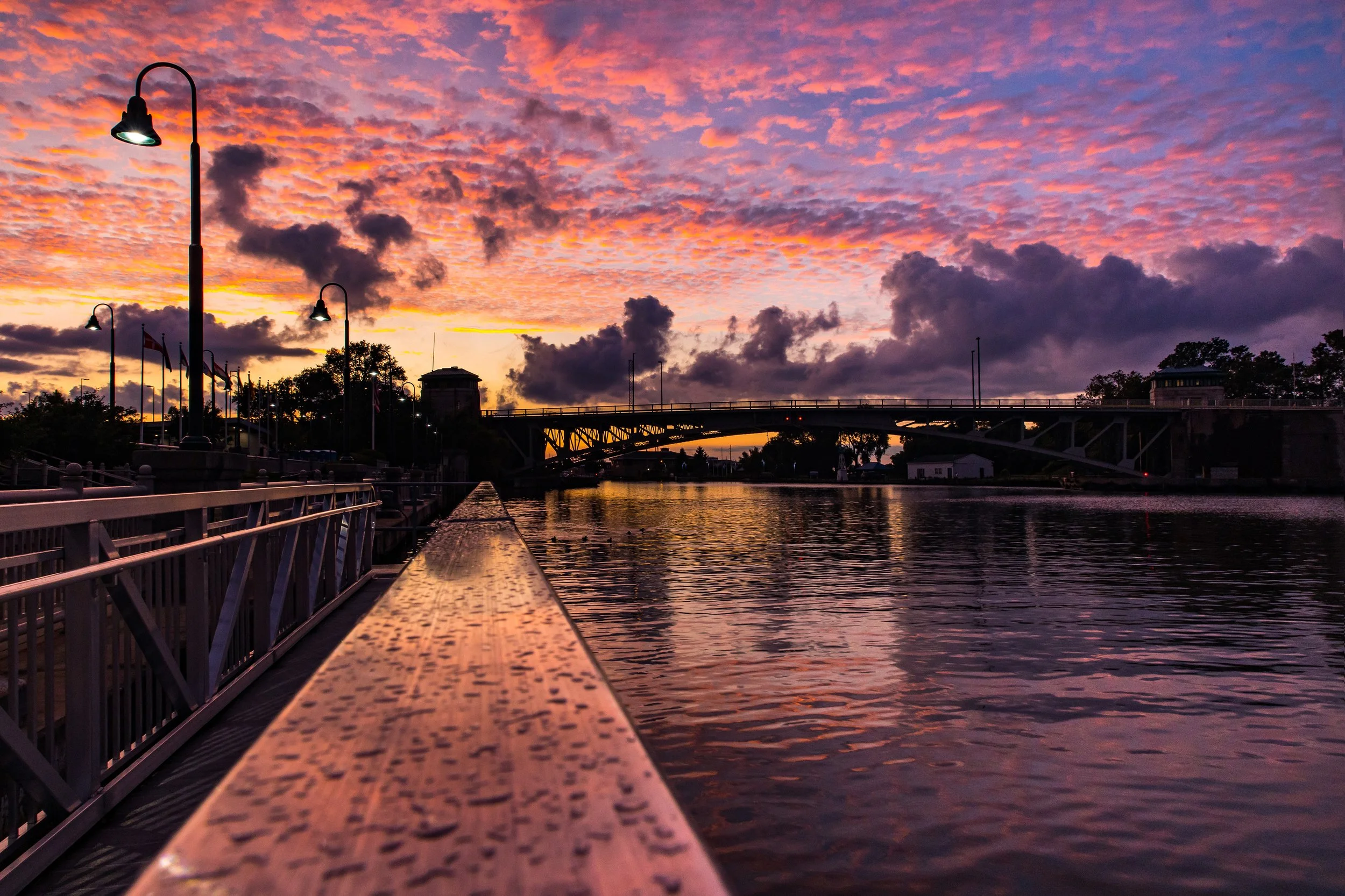
Lorain does not have a convention center or exhibition hall. Its identity is a working Lake Erie port and former steel and shipbuilding city, with a downtown along Broadway and the Black River waterfront that hosts community festivals, including the city's long-running International Festival, rather than commercial trade shows. Exhibitors based here travel into Cleveland for the region's major venues.
Our Lorain work splits between waterfront and downtown community event support — festival vendor setups, staging, and signage — and shipping or booth fabrication for Lorain-based manufacturers and businesses exhibiting at Cleveland trade shows. The city's industrial base, smaller than its steel-era peak but still present along the river, generates a steady stream of that second category.
Lorain's port and river geography also means some deliveries here deal with different access constraints than a typical suburb — waterfront staging areas, bridge weight limits on some Black River crossings, and event footprints that stretch along the river rather than sitting on a single lot.
Lorain, OH execution priorities
- Downtown Lorain and Black River waterfront festival and community event support
- Booth builds and shipping for Lorain-based manufacturers exhibiting at Cleveland shows
- International Festival and Broadway corridor vendor setup and signage
- Freight routing via I-90 with attention to Black River crossing and dock access
- Storage and refurbishment for repeat industrial and manufacturing clients
A port city without a convention venue
Lorain's downtown and waterfront grew up around its port and steel industry rather than a civic convention district, and that history still shapes the city today: a working harbor, a Broadway corridor lined with historic storefronts, and community events tied to the Black River rather than a purpose-built exhibition hall. Companies here needing a trade show floor travel into Cleveland, about 35 minutes east on I-90.
Lorain's own event calendar runs on community festivals, most notably the city's long-standing International Festival celebrating its immigrant manufacturing workforce history, plus smaller waterfront and downtown Broadway events through the summer season.
Downtown Broadway and the Black River waterfront
The Broadway corridor and the Black River waterfront host most of Lorain's public events, from the International Festival to smaller markets and community gatherings. These events run at community-festival scale rather than trade show scale, with vendor tents, stages, and signage sized to a downtown street or waterfront lot rather than a convention floor.
Waterfront staging in particular requires attention to ground conditions and access near the river, and we scout each site ahead of setup rather than assuming a standard flat, paved lot the way we would for a typical convention center loading area.
Freight routing and river crossings
Advance warehouse coordination for Lorain jobs paths through our Cleveland facility, with drayage trucks running west on I-90 into the city. Depending on the exact destination, some paths cross the Black River, and older bridges in the area carry weight and clearance limits that matter for larger delivery trucks, so we confirm routing in advance rather than defaulting to the shortest path.
Downtown Broadway and waterfront event deliveries also require confirming street closures and vendor load-in windows with city and festival organizers, since these are municipal events rather than a single venue with one point of contact.
Expo logistics and shipping for Lorain's industrial clients follows a more standard pattern, closer to what we run for any other Cleveland-area manufacturer, since those shipments go to a fixed convention center dock rather than a temporary street or park setup.
Booth and display builds for Lorain's industrial base
Manufacturers and industrial suppliers based in Lorain who exhibit at Cleveland trade shows get the same custom exhibit builds and modular exhibit systems as any of our other clients, fabricated at our Cleveland shop and shipped to the actual show venue. Downtown festival and community vendors more often need portable display systems and large-format printing for banners and signage sized to a street-fair booth space.
Exhibit graphics production for Lorain's industrial exhibitors sometimes draws on the city's port and manufacturing imagery directly, since companies with a long local history often want that heritage reflected in trade show branding rather than a generic corporate look.
Labor for festivals and industrial clients
Crews for Lorain's downtown and waterfront festivals are sized for single-day or weekend community events, with setup and teardown timed to street closure schedules rather than a convention hall's fixed move-in window. Crews supporting Lorain-based manufacturers' trade show booths work at the destination Cleveland venue, following our standard install and dismantle process there.
Waterfront and Broadway corridor jobs also mean coordinating with city crews handling street closures and traffic control, since our setup schedule has to fit inside the windows the city sets for a public event rather than the fixed, negotiated hours of a private venue contract.
Lodging near Lorain
Lorain has hotel options along the SR-2 and I-90 corridor sufficient for teams working local festivals or community events without traveling into Cleveland. During the International Festival and other peak summer weekends, we book lodging further ahead, since the event draws visitors from across the region and fills nearby hotel inventory faster than an average week.
Teams working an industrial client's Cleveland trade show booth after wrapping a Lorain job typically relocate to a Downtown Cleveland hotel for the show itself, keeping travel simple rather than commuting back and forth along I-90 each day.
Lorain's industrial and port history
Lorain's steel and shipbuilding legacy, once centered on a major US Steel plant along the river, still shapes the city's manufacturing base today, smaller than its mid-century peak but active, and generates a steady flow of exhibitors headed to Cleveland trade shows in industrial, supply chain, and manufacturing planning groups. The Port of Lorain also continues limited commercial shipping activity, adding a logistics dimension to the local economy beyond retail and festivals.
That industrial character means Lorain exhibitors often need technical product demonstration space at their trade show booth more than large-format branded graphics, which we account for in booth layout and structure recommendations.
Planning a Lorain event or shipment
For downtown or waterfront community events, we confirm street closure permits, vendor load-in windows, and any bridge or road weight restrictions well ahead of the event date. For industrial clients shipping to a Cleveland trade show, we handle it as a standard advance warehouse job, with the Lorain facility as the point of contact rather than the shipping destination.
One team for Lorain events and Cleveland shows
Lorain's community festivals, waterfront events, and industrial exhibitors headed to Cleveland trade shows all run through the same account management and fabrication shop, so a manufacturer sponsoring a local festival booth and also exhibiting at a Cleveland trade show works with one point of contact for both.
That continuity extends to storage between events as well, keeping a Lorain manufacturer's trade show structure ready at our Cleveland facility rather than tying up space at a local plant that was not built for exhibit storage.
Trade show work in Lorain, OH
Lorain, OH is one of the Cleveland area submarkets we cover for trade show work.
Lorain, OH sits in the Lorain County area.
Projects in Lorain, OH get scoped the same way as work in the Cleveland core: venue, dates, footprint, and budget frame first, then the build plan. The difference is usually in freight routing and which nearby buildings are the closest fit.
Cleveland trade show market
Exhibiting in Cleveland means working inside an established event ecosystem. The venues, the labor model, and the local production capacity all behave in predictable patterns.
Trade show weeks in Cleveland compress decisions. Dock windows are finite, rigging slots fill fast, and the labor calendar around a citywide conference runs hot. Exhibitors who treat planning as optional lose time they don't get back.
the market with roughly 24,000 hotel rooms across Northeast Ohio, about 5,000 rooms in 18 downtown hotels, 600 connected rooms at the convention-center campus, and roughly 3,000 rooms within five miles of Cleveland Hopkins International Airport — a useful reference point when sizing a project.
Cleveland Hopkins International Airport reported more than 10 million annual passengers and 47 nonstop destinations, which materially supports exhibitor, crew, and attendee lift into the market, which sets the practical ceiling for a booth program working the market.
Cleveland convention venues and meeting properties
The building matters more than almost anything else in a trade show plan. A few Cleveland venues carry most of the calendar.
Across the Cleveland venue set, what changes between buildings are the labor model, the rigging approval path, the drayage setup, and the published move-in window. The plan has to match the specific building.
Cleveland Public Auditorium is one of the anchors. Cleveland Public Auditorium is directly connected to the Huntington Convention Center.
Public Auditorium includes a 10,000-seat stadium-style auditorium.
Hilton Cleveland Downtown. The property is a 600-room Hilton connected to the downtown campus.
Hotel Cleveland: destination Cleveland’s winter 2025 meetings update says Hotel Cleveland reopened after a $90 million renovation.
Cleveland labor and venue services
Most of what goes wrong on a Cleveland install traces back to assumptions about labor. Staying inside the venue's published rules for the specific show prevents it.
Practically, that means pulling the current exhibitor manual for every show and confirming a handful of items in writing: which tasks the venue's house crews cover, which tasks the show's general contractor covers, and what an exhibitor or their appointed contractor can handle without escalation.
At Huntington Convention Center of Cleveland, full-time employees of the exhibiting company or show management may set up computers, which is a narrow but important exception to more general labor assumptions.
Cleveland labor requirements vary by venue, organizer, and current exhibitor manual. At the Huntington Convention Center, certain union jurisdictions may apply depending on the event.
Scope in Lorain, OH Cleveland, OH
Projects in Lorain, OH Cleveland, OH typically include design work, fabrication or rental sourcing, graphics production, show-service paperwork, freight, install, show-hours coverage, and strike.
What shows up in most budgets: structure, graphics, AV, show-service orders through the venue, labor, freight, supervision days, and closeout. Individual projects layer or remove items based on scope.
A well-run project has few surprises on install day because the handoffs upstream were tight. A bad one has many, because they weren't.
Multi-show programs add asset management: storage, refurbishment, graphic swaps, and scheduled re-kitting so the booth rolls cleanly from Cleveland to the next city on the calendar.
Out of scope by default are show organizer fees, booth lease costs paid directly to the show, staff travel and per diems, and any custom software or data-capture tooling the client runs on its own stack. Those stay on the client side and plug into the project through coordination, not rebilling.
The process from start to finish
Every engagement begins the same way. The venue, the show dates, the footprint, and the target outcome go on the table first. From those four inputs, a real plan can be built.
After the brief, the work turns to the building itself. Dock windows, utility orders, rigging approvals, and labor calls are all confirmed in writing before anything goes to fabrication.
Production covers fabrication, graphics, AV spec, rentals, and crew chief assignment. It is the longest phase of most projects and the one where timelines are either protected or lost.
Install days are owned by a single show floor lead. That person carries the plan, works the punch list in real time, and reports up once a day with real status.
Throughout show hours, the show floor lead stays present. Tech breaks, sponsor changes, venue requests — all handled without pulling the client team off the floor.
Strike and closeout happen the same day. Storage labels, outbound manifests, vendor performance notes, and a written debrief go out within 24 hours of doors closing.
Budget and timeline
Every project has the same cost drivers. The number depends on scope, and scope depends on a handful of specific variables.
Six variables drive the cost: custom versus rental, booth footprint and complexity, venue-specific labor and rigging fees, graphics scope and substrate, freight distance and timing, and the number of on-site supervision days.
Lead time drives everything. Custom: 16 to 20 weeks. Rental: 8 to 12. Under 4 weeks is possible but narrows choices and raises cost.
What a successful project looks like
The measure of a good engagement is simple: on-time install, no venue callouts, clean show hours, and a closeout that makes the next event easier to book.
Most programs in Cleveland are evaluated on lead-capture volume, meetings booked on the floor, and qualified-pipeline attribution after the show. The booth is a means to those numbers — it is not the number itself.
A week after the show, the booth's actual floor performance is already clearer than any pre-show projection. We document those observations alongside the technical closeout so the next cycle inherits real signal, not nostalgia.
The advantage of a local Cleveland team
Trade Show Services of Cleveland is built for exhibitors that need practical trade show execution, not a disconnected list of vendors. The work is planned from the venue outward so the schedule, floor rules, freight path, and support plan stay connected.
The value is coordination under pressure. If a graphics issue, freight delay, or venue question appears during install, the response has to be fast, documented, and connected to the actual show plan.
Consistency across show dates matters because many exhibitors reuse decisions, graphics, crates, and layouts across multiple venues. A documented plan helps the next event start from what was learned instead of starting over.
Questions about Lorain, OH
Does Lorain have a trade show or convention venue?
No. Lorain does not have a dedicated exhibition hall. It is a Lake Erie port city with a downtown Broadway corridor and Black River waterfront that host community festivals, including the International Festival, rather than commercial trade shows. Companies here needing a trade show floor travel into Cleveland.
Do you support the Lorain International Festival or other downtown events?
Yes. We handle vendor setup, staging, and signage for events along the Broadway corridor and Black River waterfront, sized to community-festival scale with setup and teardown timed to street closure schedules.
How far is Lorain from your Cleveland warehouse?
About 35 minutes via I-90. Freight for Lorain jobs paths through our Cleveland facility, with routing that accounts for Black River crossings and any bridge weight limits for larger delivery trucks.
Can you build a booth for a Lorain manufacturer showing at a Cleveland trade show?
Yes. This is a common job type for us — custom exhibit builds and modular exhibit systems fabricated at our Cleveland shop for Lorain-based industrial and manufacturing clients, shipped to the actual Cleveland show venue.
What kind of events happen on the Lorain waterfront?
Community festivals and markets along the Black River waterfront and downtown Broadway corridor, drawing local and regional visitors. These run at a smaller scale than a trade show, with vendor tents, stages, and banner signage rather than structural booth builds.
Where do exhibitor or crew teams stay for Lorain jobs?
Lorain has hotel options along the SR-2 and I-90 corridor for local festival and community work. During the International Festival and other peak summer weekends, we book lodging further ahead since regional visitor traffic fills nearby hotels faster than usual.
Do you work at Rocket Arena?
Yes. Rocket Arena operates a 'Book Your Event' section, confirming private-event and hosted-event inventory. Projects at that building are planned against its specific floor rules.
How does labor work in Cleveland?
It runs venue by venue. At IATSE Local 27, it serves as a referral hall for many major theatres, arenas, and convention halls in Cleveland and specifically lists the Huntington Convention Center, Public Auditorium, and Rocket Arena among its venue and employer information. Other Cleveland venues have their own published rules, and the plan matches the specific building.
How much lead time is ideal?
Custom builds run best with 16 to 20 weeks of lead time. Rentals take 8 to 12 weeks. Work inside 4 weeks is possible but raises costs and narrows the options.
What information kicks off a project?
The show, the venue, the booth number, the dates, and a target budget range. From those, an initial scope and a realistic cost come back within a few days.
Who runs the booth on-site?
One named show-site lead runs the install, the show hours, and the strike. That person carries the floor plan and the punch list from crates to doors and reports up once a day.
Can the booth travel to the next city on our calendar?
Yes — builds are designed for modular reuse unless single-use scenic is specifically required. Same structure, swappable graphics, standard crates. Cleveland programs that roll to another city on the same calendar get handled end to end.
What happens if something breaks during show hours?
The show floor lead handles it. Minor repairs happen in place; anything larger gets sourced from the local fabricators or rerouted through the venue's service desk.