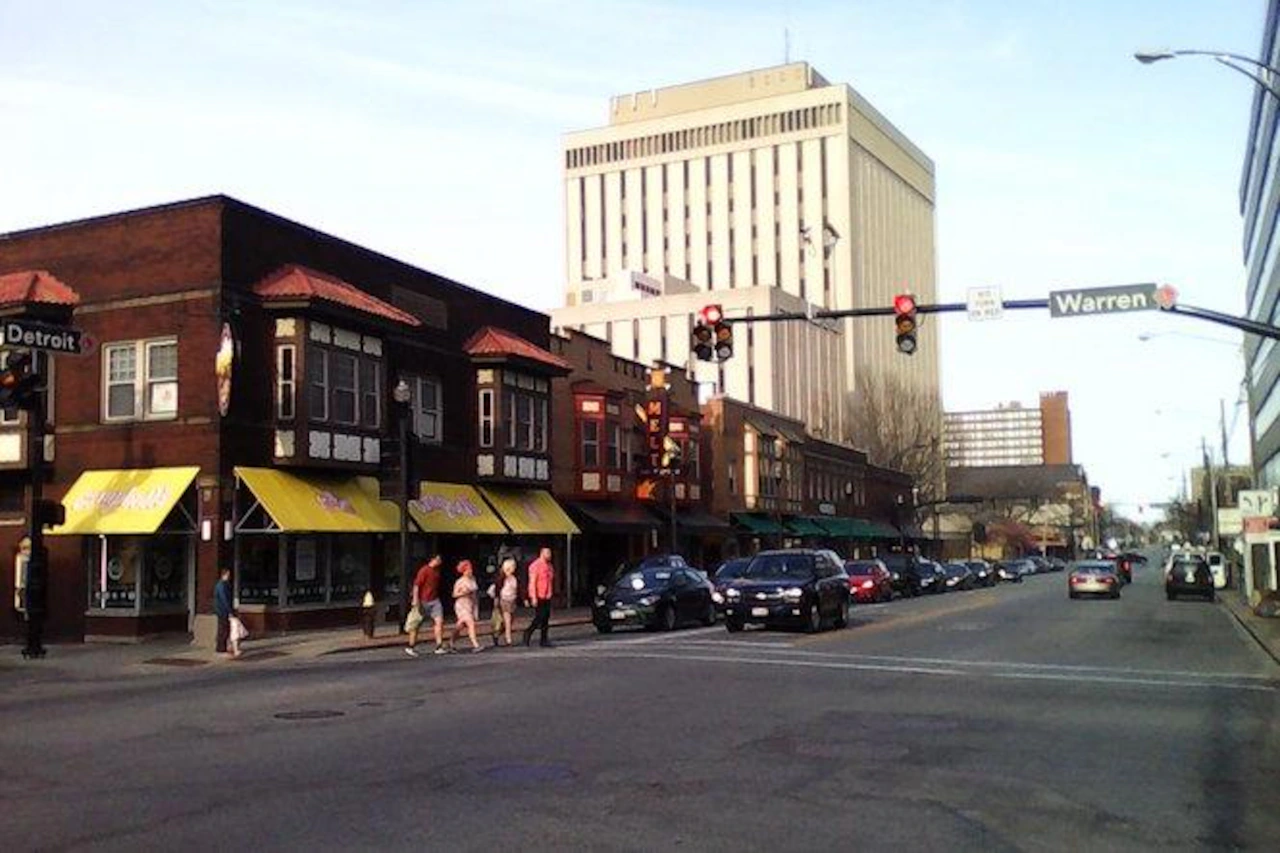
Lakewood is the densest suburb on Cleveland's west side, a walkable grid of prewar apartment blocks, Detroit Avenue storefronts, and corporate offices packed into five square miles between the lake and the Cleveland border. Companies headquartered here, from healthcare administrators to consumer brands along Warren Road, exhibit downtown far more often than they exhibit at home, because Lakewood itself has no convention floor of its own. That proximity is the advantage: a Lakewood office is closer to Huntington Convention Center than most of downtown's own residential towers.
We treat Lakewood as a staging point, not a destination. Booth components built or refurbished at our shop move down Detroit Avenue or the Shoreway in under fifteen minutes to reach Huntington Bank Field, Rocket Arena, or the convention center floor, which means late booth changes and last-minute graphics reprints do not cost a show day. Crews based here also cover the Gordon Square, Cleveland and Detroit-Shoreway arts corridor just across the city line, where smaller activations and pop-up brand events happen more often than formal trade shows.
What differs in Lakewood is parking and loading, not distance. Streets here are narrower and metered more aggressively than the suburbs further out, and freight trucks staging a booth build often need a permit or a specific curb cut rather than an open lot. We plan around that rather than around driving time, because driving time was never the constraint.
Lakewood, OH execution priorities
- Downtown venue access under fifteen minutes
- Curbside loading and permit coordination on dense streets
- Booth refurbishment staged close to convention center floors
- Detroit-Shoreway and Gordon Square, Cleveland activation support
- Rapid graphics reprint turnaround before show open
Why Lakewood exhibitors build downtown, not at home
Lakewood has no arena, convention hall, or exhibit-scale hotel ballroom of its own, so every serious trade show a Lakewood company enters happens somewhere else, almost always downtown. That is normal for this neighborhood and it is not a disadvantage. Detroit Avenue puts a Lakewood office within a fifteen-minute drive of Huntington Convention Center, Rocket Arena, and Huntington Bank Field, closer in practice than several downtown addresses that sit behind one-way grids and stadium event traffic.
The companies we work with here range from healthcare and insurance administrators near the Lakewood-Cleveland border to smaller consumer and hospitality brands along Warren Road and Madison Avenue. Most exhibit two or three times a year regionally and treat the Lakewood office as a staging and storage point between shows, not as an event site.
Getting a booth from Lakewood to the show floor
Two corridors carry nearly all of our freight in and out of Lakewood: Detroit Avenue directly into downtown, and the Shoreway when Detroit Avenue traffic backs up around a Guardians or Browns game. Both paths put a loaded box truck at the Huntington Convention Center dock in well under fifteen minutes outside of event traffic, and we build our drayage windows around whatever is actually happening downtown that week rather than a generic estimate.
Because the drive is short, we favor incremental deliveries over one large move when a show has a long build window. Graphics, small hardware, and last-minute signage move down separately from the main structural freight, which keeps the Lakewood shop working on the next show instead of sitting idle waiting on a single big truck.
Working around Lakewood's street layout and parking
Lakewood's grid was built for streetcars and rowhouses, not box trucks, and that shows up most on Detroit Avenue and Madison Avenue where curb space is metered and narrow. When we stage a build or a rehearsal out of a Lakewood location, we scout the specific block first and pull a temporary loading permit through the city rather than assuming a truck can simply park.
Alleys behind the Detroit Avenue storefronts offer more forgiving access for smaller vans, and several of the newer mixed-use buildings near the Lakewood-Cleveland line include a loading bay we can reserve in advance. None of this changes what happens at the actual venue downtown; it only affects how we get material out of Lakewood in the first place.
Booth refurbishment and storage close to the show floor
Several exhibitors keep modular booth components in storage near Lakewood between shows rather than shipping them back to a national warehouse after every event. That keeps refurbishment turnaround short: a scuffed panel or a graphics update can go from our shop to Huntington Convention Center or the I-X Center in a single afternoon instead of a multi-day freight cycle.
This matters most for companies running the same booth at three or four regional shows a year. We inspect, repair, and repack the structure here between events, so the piece that arrives on the next show floor looks new rather than road-worn.
Hotel and crew lodging for downtown shows
Lakewood-based staff and out-of-town crew working a downtown show generally stay downtown rather than in Lakewood itself, since properties like the Westin, the Renaissance, Hotel Cleveland, and the Hyatt Regency at the Arcade sit inside walking distance of the convention center and the arena district. Lakewood's own lodging stock is limited to a handful of smaller independent hotels, none built for exhibitor crews or block bookings.
We coordinate room blocks at the downtown properties directly, factoring in whatever else is booked that week, since a Guardians homestand or a concert at Rocket Arena can tighten downtown inventory with little notice.
Event types that fit a Lakewood-based team
Regional healthcare, insurance, and professional-services exhibitors headquartered near Lakewood tend to run modest twenty-by-twenty or twenty-by-thirty booths at downtown conventions, supplemented by smaller pop-up activations in Gordon Square, Cleveland or the Detroit-Shoreway corridor when a brand wants neighborhood visibility rather than a trade floor. Both formats draw on the same crew and shop, just at different scales.
We size crews and freight differently for each: a convention center booth needs drayage coordination and dock scheduling, while a Gordon Square, Cleveland storefront activation needs street permits and a smaller, faster install crew instead.
Seasonal timing around Lakewood and the lakefront
Winter lake-effect snow off Lake Erie hits Lakewood and the immediate shoreline harder than it hits venues further inland, which matters for any January or February build that starts with an early-morning load-out from a Lakewood storage location. We build extra time into the schedule for that stretch specifically, rather than applying a blanket winter buffer to every month.
Spring and fall carry the heaviest regional trade show calendar downtown, which is also when Detroit Avenue and the Shoreway see the most competing event and commuter traffic. We flag those weeks early so a Lakewood-based team knows what to expect before booking a tight build window.
Labor and crew sourcing from the west side
A meaningful share of our install and dismantle labor lives on Cleveland's near west side, including Lakewood, which shortens call times for early builds and reduces the overtime that comes with crews commuting in from further out. That local labor base is one reason a Lakewood-adjacent build can start earlier in the morning than a comparable show staged from the far eastern or southern suburbs.
We also draw specialized labor, riggers and AV technicians in particular, from the same west-side pool when a show calls for it, keeping the crew familiar with the downtown docks and loading patterns rather than learning them fresh each time.
How we plan a Lakewood-based show from the start
Planning starts with the actual venue, not the neighborhood, because Lakewood companies are almost always exhibiting somewhere else. We confirm dock hours, drayage rules, and any union labor requirements at Huntington Convention Center, Rocket Arena, or wherever the show lands, then build the Lakewood side of the schedule, shop time, storage, and local transport, around that.
For repeat exhibitors we keep a standing file on booth condition, past drayage costs, and preferred hotel blocks so each new show starts from what worked last time rather than from a blank sheet.
The Cleveland event landscape
Cleveland runs one of the busiest trade show calendars in the region. Convention weeks stack close together, hotel blocks compete for the same nights, and the venues themselves shape what is possible on the floor.
Exhibitors pulling back on budget in Cleveland still have to show up in the same booth neighborhoods as their competitors. Scope gets tighter; standards don't. The booths that land well are the ones built on a specific plan, not a standard layouts.
Destination Cleveland’s winter 2025 update says the Cleveland Museum of Natural History reopened more than 375,000 square feet of transformed space in late 2024 and that the Rock & Roll Hall of Fame expansion is creating a new 2,800-person indoor event venue, which sets the practical ceiling for a booth program working the market.
Venue marketing from Rocket Arena and Huntington Bank Field shows the downtown market is not limited to ballroom work; it also supports arena, stadium, and premium-space event programs that matter for sponsor activations and hospitality builds — a useful reference point when sizing a project.
The buildings that host Cleveland events
Different Cleveland venues mean different floor plans, different labor rules, and different freight realities.
A venue walk — either in person or via the published floor plan — is the step that reveals constraints no spec sheet shows. Column spacing, real ceiling height at the grid point, and dock access shape what's actually buildable.
Rock & Roll Hall of Fame. It can host events for 20 to 2,000 people on its host-an-event section.
How Cleveland floor operations work
Labor in Cleveland runs venue-by-venue, not citywide. Each building publishes its own rules for who handles what on the floor.
Practically, that means pulling the current exhibitor manual for every show and confirming a handful of items in writing: which tasks the venue's house crews cover, which tasks the show's general contractor covers, and what an exhibitor or their appointed contractor can handle without escalation.
Huntington Convention Center of Cleveland — The convention center is a union facility and that certain union jurisdictions may apply based on the needs of the event.
Practical planning rules for Lakewood, OH Cleveland, OH in Cleveland: Cleveland labor requirements vary by venue, organizer, and current exhibitor manual. At the Huntington Convention Center, certain union jurisdictions may apply depending on the event.
Line items on a typical project
Projects in Lakewood, OH Cleveland, OH typically include design work, fabrication or rental sourcing, graphics production, show-service paperwork, freight, install, show-hours coverage, and strike.
Typical line items include booth structure (custom or rental), graphics and print, AV and lighting, show-service orders (power, internet, rigging), labor calls against the venue's rules, freight both ways, on-site supervision, and post-show closeout documentation.
The handoffs on a project in Lakewood, OH Cleveland, OH matter almost as much as the line items. Design has to hand a build-ready drawing to fabrication. Fabrication has to hand a pre-built, dry-fitted booth to crating. The crater has to hand a labeled, manifested shipment to the carrier. Every handoff is a place quality can drop.
For programs that repeat, asset management becomes part of the engagement — storage, graphic rotation, refurbishment, and re-crating are planned rather than one-off.
A clean scope definition also calls out what isn't included: show organizer fees, client staff travel, and anything the client already has under contract (lead capture platforms, CRM integrations, promotional giveaways). Those run alongside the engagement rather than inside it.
How a project runs
Every engagement begins the same way. The venue, the show dates, the footprint, and the target outcome go on the table first. From those four inputs, a real plan can be built.
Venue coordination comes next. That means pulling the current exhibitor manual, confirming dock and freight windows, submitting rigging approvals where needed, and placing utility orders against the building's published specs.
Production brings the plan into physical form: fabrication, graphics, AV, rentals, and the named lead who will run the floor.
Install days are owned by a single show floor lead. That person carries the plan, works the punch list in real time, and reports up once a day with real status.
During show hours, the booth functions as a live operating space. A booth supervisor manages repairs, sponsor requests, lead-capture issues, and any venue questions so client staff can focus on conversations.
Closeout is tight: strike, crate, manifest, storage designation, and a written post-show report delivered within a day. That document drives the next booking.
Pricing and scheduling
Pricing is driven by real line items: fabrication or rental, graphics, show services, labor, freight, and travel where it applies. Round numbers without that breakdown usually hide something.
Cost scales with how it is built, how big it is, what the venue charges for its own services, what the graphics look like, how far the crates travel, and how many days the team stays on-site.
Lead time drives everything. Custom: 16 to 20 weeks. Rental: 8 to 12. Under 4 weeks is possible but narrows choices and raises cost.
What a successful project looks like
A successful project in Cleveland looks like a booth that lands on time, passes venue inspection on the first walk, runs without incident through show hours, and ships out the same day it strikes.
Trade show ROI is measured at the lead and pipeline level. The show-floor execution either protects or undermines those numbers.
A week after the show, the booth's actual floor performance is already clearer than any pre-show projection. We document those observations alongside the technical closeout so the next cycle inherits real signal, not nostalgia.
What makes our work different
Trade Show Services of Cleveland is built for exhibitors that need practical trade show execution, not a disconnected list of vendors. The work is planned from the venue outward so the schedule, floor rules, freight path, and support plan stay connected.
The difference shows up before the dock opens. A clear project owner can confirm what the building requires, what the show organizer controls, which tasks belong to house services, and which decisions need client approval before the schedule gets tight.
Repeat programs benefit when the plan captures what happened on the floor: what arrived late, what drew traffic, what took too long to assemble, and what should change before the next show.
Lakewood, OH — what the area looks like for events
Lakewood, OH is one of the Cleveland area submarkets we cover for trade show work.
Lakewood, OH sits in the Inner west suburbs area.
Projects in Lakewood, OH get scoped the same way as work in the Cleveland core: venue, dates, footprint, and budget frame first, then the build plan. The difference is usually in freight routing and which nearby buildings are the closest fit.
Questions about Lakewood, OH
Does Lakewood have its own convention venue?
No. Lakewood has no arena or convention-scale hotel ballroom. Exhibitors based here travel downtown, typically to Huntington Convention Center, Rocket Arena, or Huntington Bank Field, which are all under fifteen minutes away via Detroit Avenue or the Shoreway.
How do you handle loading and parking on Lakewood's narrow streets?
We scout the specific block ahead of a build and pull a temporary city loading permit rather than assuming open curb space. Alleys behind Detroit Avenue storefronts and loading bays in newer mixed-use buildings near the Cleveland line offer more reliable access for smaller vehicles.
Can you store and refurbish booths near Lakewood between shows?
Yes. We keep modular components in storage close to Lakewood, inspect and repair them between events, and can move a refreshed booth to Huntington Convention Center or the I-X Center within a single afternoon rather than a multi-day freight cycle.
Where do out-of-town crew stay for a downtown show staged from Lakewood?
Almost always downtown rather than in Lakewood itself. Properties like The Westin Cleveland Downtown, the Renaissance Cleveland Hotel, Hotel Cleveland, and the Hyatt Regency at the Arcade sit within walking distance of the convention center and arena district and handle exhibitor block bookings directly.
Do you support smaller activations in Gordon Square, Cleveland or Detroit-Shoreway?
We do. Those activations need street permits and a compact install crew rather than dock scheduling and drayage coordination, so we size the crew to match the storefront format.
What time of year is hardest for a Lakewood-based build?
Late January and February, when lake-effect snow off Lake Erie hits the immediate shoreline hardest and can slow an early-morning load-out. We build extra time into the schedule specifically for that window rather than applying the same buffer year-round.
Do you work at Huntington Convention Center of Cleveland?
Yes. Venue materials say the center provides over 520,000 square feet of meeting and event space. Projects at that building are planned against its specific floor rules.
How does labor work in Cleveland?
It runs venue by venue. Huntington Convention Center of Cleveland: Edlen Electric handles electrical and plumbing services on an exclusive basis, and the exhibitor services portal covers electrical, plumbing, air, water, internet, booth cleaning, catering, and rigging. Other Cleveland venues have their own published rules, and the plan matches the specific building.
How much lead time is ideal?
Custom builds run best with 16 to 20 weeks of lead time. Rentals take 8 to 12 weeks. Work inside 4 weeks is possible but raises costs and narrows the options.
What information kicks off a project?
The show, the venue, the booth number, the dates, and a target budget range. From those, an initial scope and a realistic cost come back within a few days.
Who runs the booth on-site?
One named show-site lead runs the install, the show hours, and the strike. That person carries the floor plan and the punch list from crates to doors and reports up once a day.
Can the booth travel to the next city on our calendar?
Yes — builds are designed for modular reuse unless single-use scenic is specifically required. Same structure, swappable graphics, standard crates. Cleveland programs that roll to another city on the same calendar get handled end to end.
What happens if something breaks during show hours?
The show floor lead handles it. Minor repairs happen in place; anything larger gets sourced from the local fabricators or rerouted through the venue's service desk.