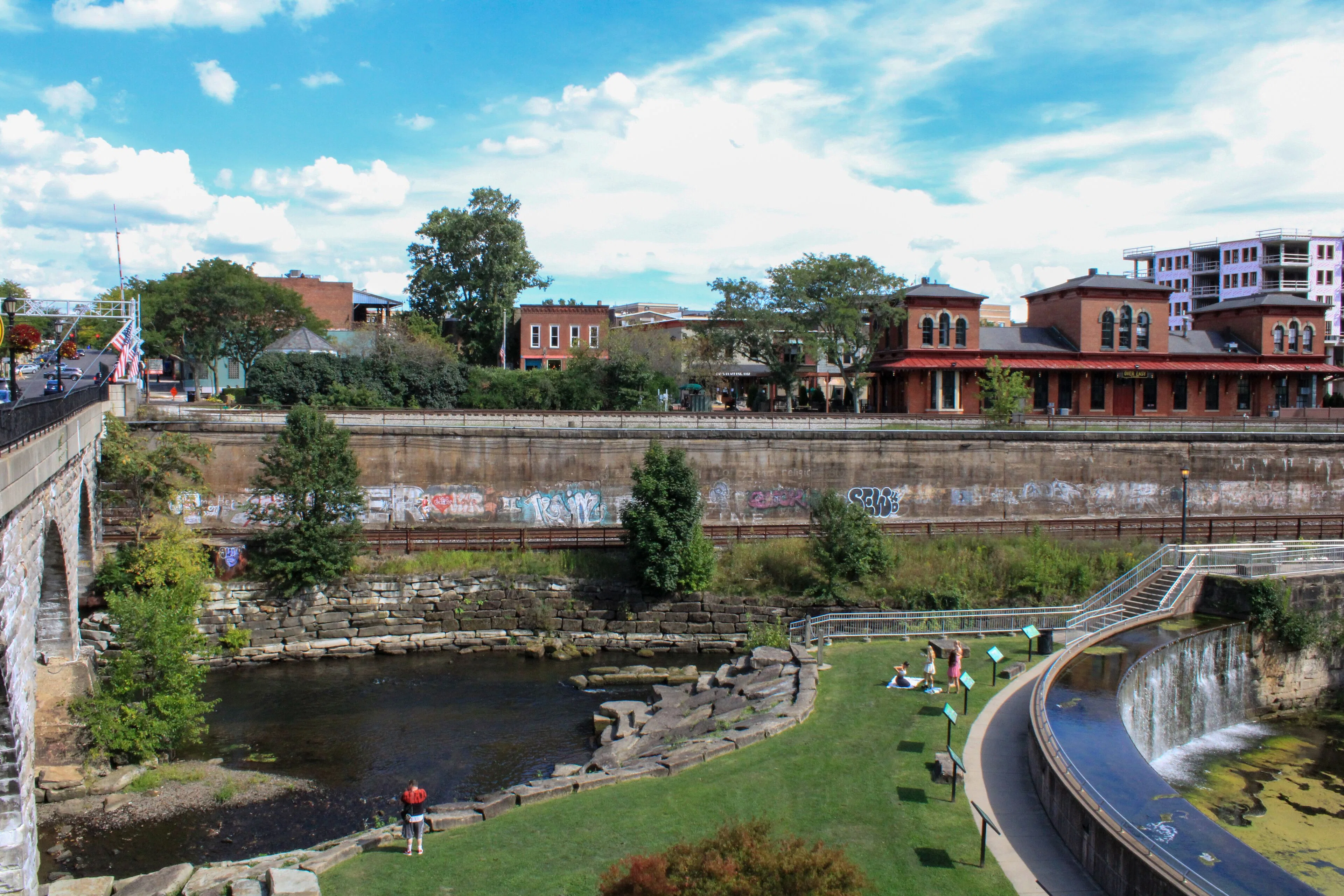
Kent is a Portage County market rather than a Summit County one, and its event calendar runs largely through Kent State University: academic conferences, career and industry fairs, athletics-related functions, and the Kent State University Center for the Performing Arts, which hosts touring productions, lectures, and community events. Downtown Kent, led by the Acorn Alley redevelopment, adds a second layer of smaller retail and community programming.
Most of our Kent work falls into university-affiliated events — recruiting and career fairs, departmental conferences, and event support tied to the M.A.C. Center arena — plus corporate shipping for the smaller manufacturing and services base in the area. Kent does not have a general-purpose convention hall, so exhibitors needing a full trade show floor travel into Cleveland or occasionally to the Knight Center in Akron.
The university drives a different rhythm than a corporate or civic market: event dates cluster around the academic calendar, with heavier demand during fall move-in, spring career fair season, and commencement, and lighter demand during summer and winter breaks.
Kent, OH execution priorities
- Kent State University career fairs, conferences, and Center for the Performing Arts events
- M.A.C. Center arena event support for university and community functions
- Downtown Kent and Acorn Alley community and retail event coordination
- Corporate shipping for the smaller Portage County manufacturing base
- Scheduling tied to the academic calendar's peak event windows
Kent State University as the area's main event driver
Kent State's main campus generates most of the recurring event demand in this market: academic conferences, departmental symposiums, and large recruiting and career fairs that draw regional employers as exhibitors. These events run through university facilities rather than a public convention center, with their own booking calendars, dock access rules, and move-in windows that differ building to building across campus.
The Kent State University Center for the Performing Arts adds touring productions, lectures, and larger community events to the calendar, occasionally calling for staging, signage, or AV support beyond what the venue's in-house team handles for its regular season.
The M.A.C. Center and campus event spaces
The M.A.C. Center, Kent State's arena, hosts athletics but also larger university functions, commencement-adjacent events, and occasional community gatherings that need a bigger footprint than a lecture hall or ballroom. We treat M.A.C. Center bookings more like an arena job than a standard conference room setup, with load-in through the arena's dedicated dock rather than a building's standard entrance.
Smaller academic buildings across campus host career fairs and departmental conferences with far more modest freight needs — usually portable displays and signage rather than structural booth work — but each building has its own access rules that we confirm before scheduling.
Downtown Kent and Acorn Alley
Downtown Kent's Acorn Alley district and the surrounding blocks host a smaller calendar of community festivals, retail promotions, and local business events. This work is closer in scale to what we do in Cuyahoga Falls or Hudson than to a university career fair — tabletop displays, tents, and signage rather than a full exhibit build.
Local businesses along Main Street and Water Street also occasionally book pop-up event fabrication for storefront promotions timed around university move-in weekends and homecoming, when foot traffic downtown spikes well above a typical week.
Freight routing via SR-8 and I-480
Advance warehouse coordination for Kent jobs paths through our Cleveland facility, with drayage trucks running SR-8 or I-480 depending on whether the destination is closer to campus or downtown. University loading docks vary significantly by building, and we confirm exact access before scheduling delivery, since some academic buildings were not designed with event freight in mind.
Career fair season in particular compresses a lot of delivery activity into a narrow window each semester, so we plan Kent freight further ahead during those peak weeks than we would for a standard off-season booking.
Drayage and material handling coordination on campus also has to account for pedestrian traffic and class schedules, since freight paths often cross the same walkways students use between buildings, which limits practical delivery windows to early morning or evening outside class hours.
Booth and display builds for university and corporate clients
Career fair exhibitors typically need portable display systems sized for a table or small booth space rather than a full custom build, and we keep this inventory ready for the recruiting seasons when demand from regional employers spikes. Corporate clients based in Kent's smaller manufacturing sector who show at larger trade shows elsewhere get the same custom exhibit builds fabricated at our Cleveland shop.
Multi-show program rollouts fit well for regional employers who return to the same Kent State career fairs every semester, since the same table display and graphics package can be refreshed and reused rather than rebuilt each time, cutting fabrication cost for recurring recruiting programs.
Labor for campus and downtown events
Install crews for Kent campus events work within university scheduling and security requirements, which can differ from a standard convention center process, including building access credentials and coordination with campus event staff. Downtown Kent and Acorn Alley events use a lighter crew structure matched to community-event scale.
Show site supervision on campus jobs includes a single point of contact who tracks both our crew and the university's own event staff, since larger Kent State functions often involve building services, campus police, and catering all working the same load-in window.
Lodging near Kent
Hotel options directly in Kent are limited, so exhibitor teams working multi-day university events or larger downtown functions often stay in nearby Cuyahoga Falls, Stow, or the Akron corridor, all within a 15 to 20 minute drive, or in the Cleveland-area hotels along I-480 for teams also working a Cleveland show the same week.
During commencement week and major career fair dates, hotel rooms across the wider Kent-Cuyahoga Falls-Stow area book up well in advance, so we flag those dates early for out-of-town exhibitor teams that need overnight stays.
Scheduling around the academic calendar
Kent's event demand tracks the university's calendar more than a typical civic or corporate market, with fall semester start, spring career fair season, and commencement week as the busiest stretches, and summer and winter break as the quietest. We build advance shipping deadlines and crew scheduling around that rhythm rather than treating Kent like a market with steady year-round demand.
One team for Kent and the wider Cleveland-Akron corridor
Regional employers who exhibit at Kent State career fairs and also show at Cleveland or Akron trade shows work with the same account manager and fabrication shop across all three, which keeps booth structure and branding consistent whether the audience is students on campus or attendees at a Downtown Cleveland convention floor.
That continuity also helps when a Kent career fair sponsor decides to scale up to a full trade show presence later, since we already have their graphics files and structure preferences on hand rather than starting a new build from scratch.
Trade show work in Kent, OH
Kent, OH falls inside the Cleveland service footprint for trade show projects.
Kent, OH sits in the Secondary metro area.
Projects in Kent, OH get scoped the same way as work in the Cleveland core: venue, dates, footprint, and budget frame first, then the build plan. The difference is usually in freight routing and which nearby buildings are the closest fit.
What drives the Cleveland calendar
Cleveland runs one of the busiest trade show calendars in the region. Convention weeks stack close together, hotel blocks compete for the same nights, and the venues themselves shape what is possible on the floor.
Trade show weeks in Cleveland compress decisions. Dock windows are finite, rigging slots fill fast, and the labor calendar around a citywide conference runs hot. Exhibitors who treat planning as optional lose time they don't get back.
Cleveland Clinic said on January 27, 2025 that it served the most patients in its history during 2024, reinforcing Cleveland’s continued relevance for healthcare, med-tech, and research-heavy meetings — a useful reference point when sizing a project.
The Huntington Convention Center campus publicly markets more than 520,000 square feet of meeting and event space, including 225,000 square feet of exhibit hall space, two ballrooms, and 50-plus breakout rooms.
The buildings that host Cleveland events
Different Cleveland venues mean different floor plans, different labor rules, and different freight realities.
The right building depends on the show: a consumer expo wants open aisles and broad traffic flow; a corporate conference wants controlled breakout space; a brand activation wants a venue that can carry scenic and production without fighting the architecture.
Hilton Cleveland Downtown: the property is a 600-room Hilton connected to the downtown campus.
Hotel Cleveland. Destination Cleveland’s winter 2025 meetings update says Hotel Cleveland reopened after a $90 million renovation.
How Cleveland floor operations work
Labor in Cleveland runs venue-by-venue, not citywide. Each building publishes its own rules for who handles what on the floor.
On most Cleveland shows, the labor plan takes one call with the venue's exhibitor services desk, one review of the current manual, and one email to the general contractor. Skipping any of those three is usually where problems start.
Huntington Convention Center of Cleveland — The convention center is a union facility and that certain union jurisdictions may apply based on the needs of the event.
Practical planning rules for Kent, OH Cleveland, OH in Cleveland: Cleveland labor requirements vary by venue, organizer, and current exhibitor manual. At the Huntington Convention Center, certain union jurisdictions may apply depending on the event.
Scope in Kent, OH Cleveland, OH
A full engagement covers scope development, fabrication or rental, graphics, show services, logistics, and on-site execution from move-in through dismantle.
Typical line items include booth structure (custom or rental), graphics and print, AV and lighting, show-service orders (power, internet, rigging), labor calls against the venue's rules, freight both ways, on-site supervision, and post-show closeout documentation.
A well-run project has few surprises on install day because the handoffs upstream were tight. A bad one has many, because they weren't.
For programs that repeat, asset management becomes part of the engagement — storage, graphic rotation, refurbishment, and re-crating are planned rather than one-off.
Out of scope by default are show organizer fees, booth lease costs paid directly to the show, staff travel and per diems, and any custom software or data-capture tooling the client runs on its own stack. Those stay on the client side and plug into the project through coordination, not rebilling.
How a project runs
Every engagement begins the same way. The venue, the show dates, the footprint, and the target outcome go on the table first. From those four inputs, a real plan can be built.
After the brief, the work turns to the building itself. Dock windows, utility orders, rigging approvals, and labor calls are all confirmed in writing before anything goes to fabrication.
Production covers fabrication, graphics, AV spec, rentals, and crew chief assignment. It is the longest phase of most projects and the one where timelines are either protected or lost.
Install days are owned by a single show floor lead. That person carries the plan, works the punch list in real time, and reports up once a day with real status.
Throughout show hours, the show floor lead stays present. Tech breaks, sponsor changes, venue requests — all handled without pulling the client team off the floor.
Strike and closeout happen the same day. Storage labels, outbound manifests, vendor performance notes, and a written debrief go out within 24 hours of doors closing.
What it costs and how fast it moves
Every project has the same cost drivers. The number depends on scope, and scope depends on a handful of specific variables.
Six variables drive the cost: custom versus rental, booth footprint and complexity, venue-specific labor and rigging fees, graphics scope and substrate, freight distance and timing, and the number of on-site supervision days.
Lead time drives everything. Custom: 16 to 20 weeks. Rental: 8 to 12. Under 4 weeks is possible but narrows choices and raises cost.
What a successful project looks like
The measure of a good engagement is simple: on-time install, no venue callouts, clean show hours, and a closeout that makes the next event easier to book.
Most programs in Cleveland are evaluated on lead-capture volume, meetings booked on the floor, and qualified-pipeline attribution after the show. The booth is a means to those numbers — it is not the number itself.
A week after the show, the booth's actual floor performance is already clearer than any pre-show projection. We document those observations alongside the technical closeout so the next cycle inherits real signal, not nostalgia.
How we're built to run your project
Trade Show Services of Cleveland is built for exhibitors that need practical trade show execution, not a disconnected list of vendors. The work is planned from the venue outward so the schedule, floor rules, freight path, and support plan stay connected.
The value is coordination under pressure. If a graphics issue, freight delay, or venue question appears during install, the response has to be fast, documented, and connected to the actual show plan.
Consistency across show dates matters because many exhibitors reuse decisions, graphics, crates, and layouts across multiple venues. A documented plan helps the next event start from what was learned instead of starting over.
Questions about Kent, OH
Is there a general-purpose convention center in Kent?
No. Kent does not have a public convention venue. Its event calendar runs mostly through Kent State University facilities, including the M.A.C. Center and the Center for the Performing Arts, plus a smaller downtown community-event calendar around Acorn Alley.
Do you handle Kent State University career fairs?
Yes. Career and recruiting fairs at Kent State are one of our most common Kent job types, usually needing portable display systems for regional employer exhibitors rather than a full custom booth build.
What is the M.A.C. Center and do you work events there?
The M.A.C. Center is Kent State's arena, used for athletics as well as larger university functions and community events. We support M.A.C. Center bookings with load-in through the arena's dedicated dock, treating it more like an arena job than a standard conference room setup.
How far is Kent from your Cleveland warehouse?
About 40 minutes via SR-8 and I-480. Freight for Kent jobs paths through our Cleveland facility, with the exact paths depending on whether the destination is on campus or downtown.
Does Kent's event demand follow the school calendar?
Yes. Demand clusters around fall semester start, spring career fair season, and commencement week, with summer and winter break much quieter. We plan advance shipping and crew scheduling around that pattern rather than assuming steady year-round volume.
Where do exhibitor teams stay when working a Kent event?
Hotel options directly in Kent are limited, so teams commonly stay in nearby Cuyahoga Falls or Stow, about 15 to 20 minutes away, or in Cleveland-area hotels if they are also working a Cleveland show the same week.
Do you work at Great Lakes Science Center?
Yes. Great Lakes Science Center maintains a corporate-events and private-rentals section. Projects at that building are planned against its specific floor rules.
How does labor work in Cleveland?
It runs venue by venue. Huntington Convention Center of Cleveland: Edlen Electric handles electrical and plumbing services on an exclusive basis, and the exhibitor services portal covers electrical, plumbing, air, water, internet, booth cleaning, catering, and rigging. Other Cleveland venues have their own published rules, and the plan matches the specific building.
How much lead time is ideal?
Custom builds run best with 16 to 20 weeks of lead time. Rentals take 8 to 12 weeks. Work inside 4 weeks is possible but raises costs and narrows the options.
What information kicks off a project?
The show, the venue, the booth number, the dates, and a target budget range. From those, an initial scope and a realistic cost come back within a few days.
Who runs the booth on-site?
One named show-site lead runs the install, the show hours, and the strike. That person carries the floor plan and the punch list from crates to doors and reports up once a day.
Can the booth travel to the next city on our calendar?
Yes — builds are designed for modular reuse unless single-use scenic is specifically required. Same structure, swappable graphics, standard crates. Cleveland programs that roll to another city on the same calendar get handled end to end.
What happens if something breaks during show hours?
The show floor lead handles it. Minor repairs happen in place; anything larger gets sourced from the local fabricators or rerouted through the venue's service desk.