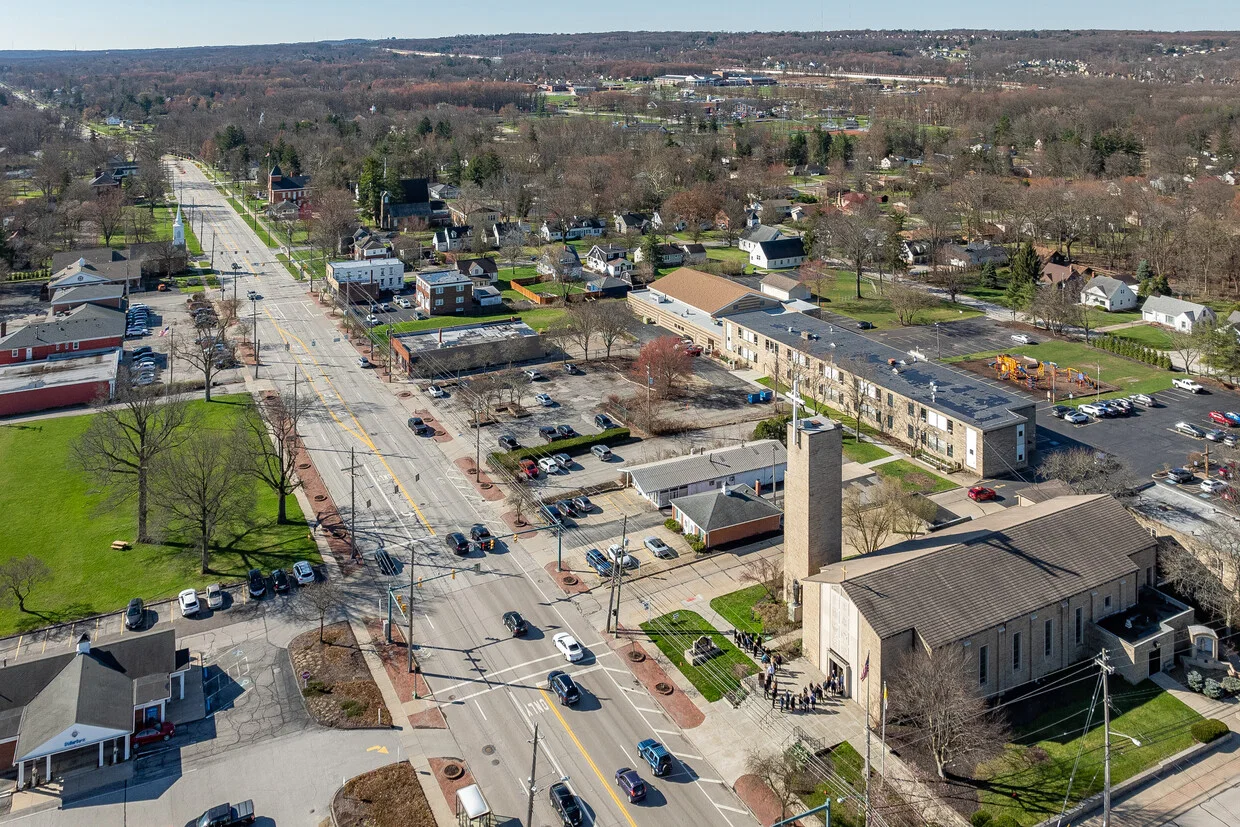
Independence is a small suburb defined almost entirely by one interchange: I-77 crossing I-480, with a corporate office park and a cluster of hotels lined up along Rockside Road and Stone Road. It is one of the more common places a regional sales team, an exhibitor's advance crew, or an out-of-town vendor books rooms and holds internal meetings before heading into Downtown Cleveland for the actual show.
That role, as a staging and meeting base rather than a show destination, shapes how we plan around it. Independence has no trade show venue of its own; every real show floor in this market is downtown or at the I-X Center. What Independence offers is a quiet, easy-access hotel corridor a few minutes off two interstates, which makes it a practical place to headquarter a multi-day program even when none of the actual show activity happens there.
We coordinate programs where the Independence hotel cluster serves as the sales team's forward base: pre-show briefings, sample-room setups, and overnight staging for smaller freight, all timed to feed into downtown move-in windows without the team fighting Cleveland's tighter downtown hotel inventory during a major show week.
Independence, OH execution priorities
- Meeting-base coordination for the Rockside Road hotel and office corridor
- Routing from the I-77/I-480 interchange into downtown venues
- Overnight staging for teams headquartered in Independence during a show week
- Sample-room and briefing-space setup separate from the official show floor
- Crew dispatch timed against I-77 interchange traffic patterns
Independence as a staging base, not a show location
No trade show venue sits in Independence itself. The suburb's identity is the interchange and the business corridor that grew up around it, home to national hotel brands and mid-size office tenants who value the quick highway access more than proximity to downtown. When a client tells us their team is staying in Independence for a Cleveland show, we plan the week around that fact rather than assuming the meeting space and the show floor are the same building.
That means building two schedules that talk to each other: one for whatever happens at the Independence hotel base, and one for the actual venue downtown, with drayage and crew movement timed to connect the two without wasted trips.
Getting from Independence to downtown venues
The run from Independence into Downtown Cleveland is a straightforward shot up I-77, typically ten to fifteen minutes outside of rush hour and closer to twenty-five during a weekday morning peak. We plan crew departures against the specific show date's traffic pattern, since a Monday morning move-in behaves very differently than a Thursday afternoon teardown.
For exhibitors headed to the I-X Center instead of downtown, the paths runs west along I-480, a slightly longer drive that we account for separately when a program has activity at both ends of the market.
We also watch for events unrelated to the trade show calendar that can back up the I-77 corridor near the interchange itself, since a stadium event downtown or a lane closure near Rockside Road can add unexpected minutes to a run that would otherwise be routine.
Using the Independence hotel corridor as a forward base
The hotel cluster along Rockside Road is a common choice for out-of-town sales teams and exhibitor staff who want easy interstate access without paying downtown convention-week rates. We help clients set up a sample room or briefing space at their Independence hotel, distinct from the official show floor, and manage the logistics of moving samples and materials between the two locations as the week progresses.
This is especially useful during major convention weeks when downtown hotel inventory tightens and a company's own team needs somewhere predictable to stage and regroup each evening.
For multi-day programs, we also handle the daily shuttle of samples, printed collateral, and giveaway inventory between the Independence base and the show floor, replenishing the booth each morning rather than trying to store a full week's worth of materials on-site downtown.
Freight staging out of the Independence office park
Independence's office park has loading capacity that some downtown locations lack, which makes it a reasonable spot to hold overflow freight or a secondary shipment overnight before a final short run into the city. We coordinate that staging with the venue's dock schedule so the Independence-held freight arrives on time rather than as an afterthought.
That capacity also makes Independence useful as a rally point when several vendors are shipping components separately for the same booth build, letting us receive and inventory each piece locally before consolidating everything into one truck for the final run downtown.
Crew logistics from the I-77/I-480 corridor
Labor crews staged out of Independence benefit from the interchange location, since it puts them within easy reach of both downtown venues and the I-X Center without a long commute either direction. We use that flexibility when a program has satellite activity in more than one part of the metro during the same week, sending the same crew to handle a downtown morning call and a west-side afternoon task without a wasted trip back through Independence in between.
Coordinating internal meetings around show logistics
A number of the programs we run out of Independence involve internal sales or dealer meetings that happen alongside a public show downtown. We keep those two workstreams separate in the schedule while still making sure the same crew and vehicles aren't double-booked trying to serve both locations on the same afternoon.
That separation matters most on the first and last day of a show, when a dealer meeting at the Independence hotel can easily overlap with the exact hour the crew needs to be handling move-in or teardown downtown, and we build the calendar to flag that conflict early rather than discovering it the morning of.
Working with Independence hotel and office facilities
We coordinate directly with hotel event staff and office-park property management in Independence to confirm loading access, meeting-room availability, and any restrictions on holding freight overnight, so the base location runs smoothly even though it isn't the show's official venue.
Seasonal and traffic considerations for the interchange
The I-77/I-480 interchange sees heavier congestion during winter weather and around major regional events unrelated to any particular show, so we build extra buffer into departure times from Independence during those windows rather than relying on a standard drive-time estimate. A stalled vehicle on the interchange itself can back traffic up in multiple directions at once, and we treat that as a real planning risk rather than a rare exception.
What a typical Independence-based program includes
A standard engagement covers hotel and office-park logistics coordination, a downtown or I-X Center drayage and crew plan tied to the actual show venue, sample-room or briefing-space setup at the Independence base, and a return plan for anything staged locally once the show closes.
Trade show work in Independence, OH
Independence, OH is part of the Cleveland event market. Shows and meetings book here alongside the larger Cleveland calendar.
Independence, OH sits in the Rockside corridor area.
Trade show work in Independence, OH shares most of its structure with larger Cleveland projects. Where it diverges is in the nearby venue mix, freight routing, and local hotel block availability.
The Cleveland event landscape
Cleveland runs one of the busiest trade show calendars in the region. Convention weeks stack close together, hotel blocks compete for the same nights, and the venues themselves shape what is possible on the floor.
The attendees vary by show — some weeks draw regional operators, others pull international buyers in for a single conference — but the floor mechanics stay consistent. Every booth needs graphics production, show services, labor calls, and a plan for the specific building it's landing in.
Destination Cleveland’s winter 2025 update says the Cleveland Museum of Natural History reopened more than 375,000 square feet of transformed space in late 2024 and that the Rock & Roll Hall of Fame expansion is creating a new 2,800-person indoor event venue — a useful reference point when sizing a project.
Venue marketing from Rocket Arena and Huntington Bank Field shows the downtown market is not limited to ballroom work; it also supports arena, stadium, and premium-space event programs that matter for sponsor activations and hospitality builds, which sets the practical ceiling for a booth program working the market.
Citywide conventions and association meetings is one of the sectors that shapes the Cleveland calendar. The Huntington Convention Center campus is large enough to support genuine convention and expo logistics, and the connected Hilton plus nearby downtown hotel stock make Cleveland workable for citywide programs rather than only one-off ballroom events.
The buildings that host Cleveland events
Different Cleveland venues mean different floor plans, different labor rules, and different freight realities.
A venue walk — either in person or via the published floor plan — is the step that reveals constraints no spec sheet shows. Column spacing, real ceiling height at the grid point, and dock access shape what's actually buildable.
Hilton Cleveland Downtown. The property is a 600-room Hilton connected to the downtown campus.
Hotel Cleveland: destination Cleveland’s winter 2025 meetings update says Hotel Cleveland reopened after a $90 million renovation.
How Cleveland floor operations work
Labor in Cleveland runs venue-by-venue, not citywide. Each building publishes its own rules for who handles what on the floor.
Practically, that means pulling the current exhibitor manual for every show and confirming a handful of items in writing: which tasks the venue's house crews cover, which tasks the show's general contractor covers, and what an exhibitor or their appointed contractor can handle without escalation.
Huntington Convention Center of Cleveland — The convention center is a union facility and that certain union jurisdictions may apply based on the needs of the event.
Practical planning rules for Independence, OH Cleveland, OH in Cleveland: Final labor assumptions should always be confirmed against the current show manual, venue team, and general service contractor. Cleveland labor requirements vary by venue, organizer, and current exhibitor manual.
What's included in the project scope
Projects in Independence, OH Cleveland, OH typically include design work, fabrication or rental sourcing, graphics production, show-service paperwork, freight, install, show-hours coverage, and strike.
Typical line items include booth structure (custom or rental), graphics and print, AV and lighting, show-service orders (power, internet, rigging), labor calls against the venue's rules, freight both ways, on-site supervision, and post-show closeout documentation.
Good execution comes from keeping the team small and the handoffs short. Every extra vendor in the chain adds a communication layer and a place where details get lost.
For programs that repeat, asset management becomes part of the engagement — storage, graphic rotation, refurbishment, and re-crating are planned rather than one-off.
Scope boundary is as important as scope inclusion. Show organizer fees, client-side staff costs, and any tools the client already owns are handled outside the engagement. Defining that boundary up front prevents billing surprises later.
How a project runs
First step on any project is pinning down the show, the floor plan, the deadlines, and what success actually looks like. Everything downstream hinges on those answers.
Once scope is clear, the venue work begins. Exhibitor manual, dock times, utility order IDs, rigging submissions for hanging elements, and labor calls all get locked against the venue's actual rules.
Production covers fabrication, graphics, AV spec, rentals, and crew chief assignment. It is the longest phase of most projects and the one where timelines are either protected or lost.
The install phase has one owner on the floor. That person handles the labor calls, the graphics questions, the sequence adjustments, and the daily update.
Show-hours coverage is part of every engagement — not a premium add-on. On-floor support keeps the booth running while the client team runs the pipeline.
Strike and closeout happen the same day. Storage labels, outbound manifests, vendor performance notes, and a written debrief go out within 24 hours of doors closing.
Pricing and scheduling
An honest quote itemizes the variables. There is not a single price — there is a configuration.
Six variables drive the cost: custom versus rental, booth footprint and complexity, venue-specific labor and rigging fees, graphics scope and substrate, freight distance and timing, and the number of on-site supervision days.
A clean schedule starts 4 to 5 months out for custom work and 2 to 3 months for rentals. Shorter lead times are workable but push rush premiums and limit material choices.
How project performance gets measured
A project runs well when install clears the venue's published window, all show services land as ordered, the booth performs across every show day without pulling the client team off pipeline work, and strike clears the dock before the next occupant loads in.
Most programs in Cleveland are evaluated on lead-capture volume, meetings booked on the floor, and qualified-pipeline attribution after the show. The booth is a means to those numbers — it is not the number itself.
Client teams sometimes want the booth to carry the pipeline on its own, but the best-performing programs treat the booth as a platform and put real operators on it. On-floor conversation discipline moves the KPIs more than any scenic decision.
What makes our work different
Trade Show Services of Cleveland supports Cleveland exhibitors with a planning model that keeps design decisions, production details, and show-site responsibilities visible before move-in begins.
Good execution depends on fewer blind handoffs. The person responsible for the plan should understand the room, the service orders, the graphics package, the install sequence, and the closeout path.
Consistency across show dates matters because many exhibitors reuse decisions, graphics, crates, and layouts across multiple venues. A documented plan helps the next event start from what was learned instead of starting over.
Questions about Independence, OH
Is there a trade show venue in Independence itself?
No. Independence has no show venue of its own; it functions as a hotel and office corridor at the I-77/I-480 interchange. The real show floors for this market are Downtown Cleveland or the I-X Center, and we paths freight and crews there while treating Independence as a staging or meeting base.
How far is Independence from Downtown Cleveland venues?
About ten to fifteen minutes under normal traffic via I-77, though that can stretch to twenty-five minutes during a weekday morning rush. We plan crew and drayage timing against the specific show date rather than a flat average.
Can you set up a sample room or briefing space at an Independence hotel?
Yes. We regularly coordinate sample rooms and internal briefing spaces at the Independence hotel corridor, kept separate from the official show floor logistics but scheduled to connect smoothly with whatever is happening downtown that same week.
Why do teams stage out of Independence instead of staying downtown?
Downtown hotel inventory tightens considerably during major convention weeks, and Independence offers reliable interstate access without competing for the same rooms. It's a practical forward base even though none of the show activity happens there.
Do you handle freight staged overnight in Independence?
Yes, when a program needs overflow or secondary freight held before a final short run into downtown or west toward the I-X Center, we coordinate that staging against the venue's actual dock schedule so nothing arrives late.
Can the same crew serve both an Independence base and a downtown venue in one day?
In many cases yes, given how close the interchange sits to both downtown and the I-X Center, though we build the schedule carefully to avoid double-booking the same crew or vehicles across two active locations.
Do you work at Great Lakes Science Center?
Yes. Great Lakes Science Center maintains a corporate-events and private-rentals section. Projects at that building are planned against its specific floor rules.
How does labor work in Cleveland?
It runs venue by venue. Huntington Convention Center of Cleveland: Edlen Electric handles electrical and plumbing services on an exclusive basis, and the exhibitor services portal covers electrical, plumbing, air, water, internet, booth cleaning, catering, and rigging. Other Cleveland venues have their own published rules, and the plan matches the specific building.
How much lead time is ideal?
Custom builds run best with 16 to 20 weeks of lead time. Rentals take 8 to 12 weeks. Work inside 4 weeks is possible but raises costs and narrows the options.
What information kicks off a project?
The show, the venue, the booth number, the dates, and a target budget range. From those, an initial scope and a realistic cost come back within a few days.
Who runs the booth on-site?
One named show-site lead runs the install, the show hours, and the strike. That person carries the floor plan and the punch list from crates to doors and reports up once a day.
Can the booth travel to the next city on our calendar?
Yes — builds are designed for modular reuse unless single-use scenic is specifically required. Same structure, swappable graphics, standard crates. Cleveland programs that roll to another city on the same calendar get handled end to end.
What happens if something breaks during show hours?
The show floor lead handles it. Minor repairs happen in place; anything larger gets sourced from the local fabricators or rerouted through the venue's service desk.