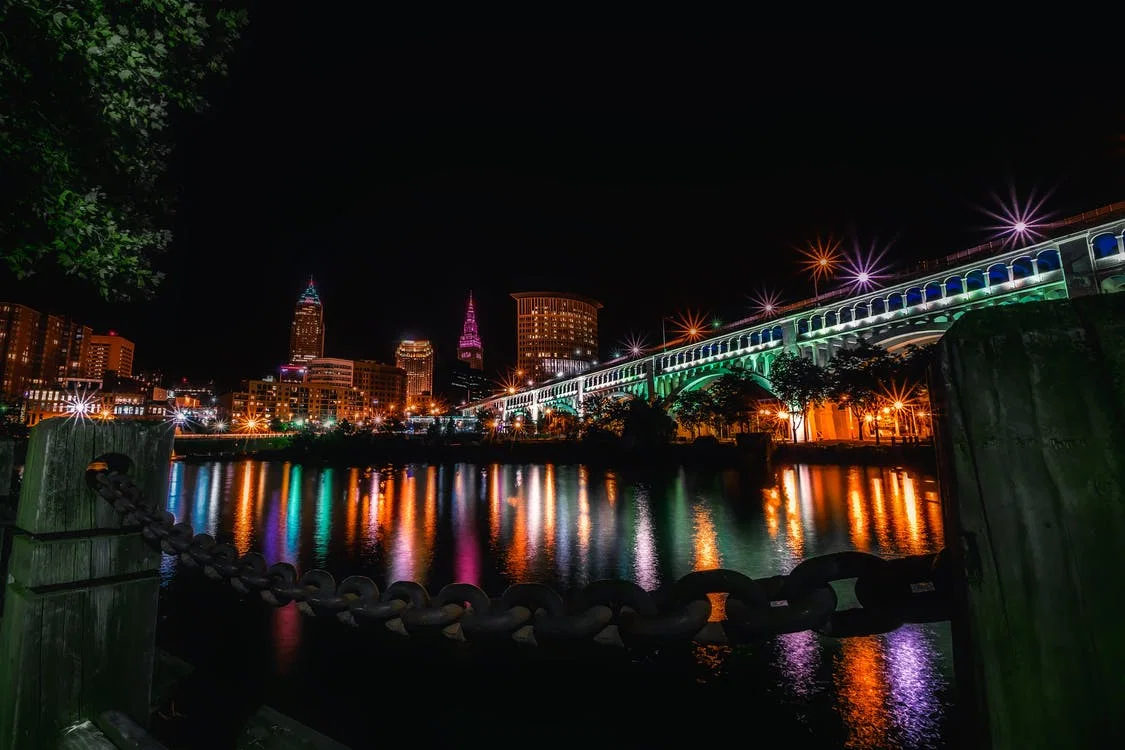
Gordon Square, Cleveland is the theater and arts district centered on the intersection of Detroit Avenue and West 65th Street, best known for the Capitol Theatre and a concentration of small performance and gallery spaces rather than any convention or exhibit infrastructure. It sits further from downtown than Ohio City, Cleveland or Tremont, Cleveland, out along the Detroit Avenue corridor toward Lakewood.
Because of that distance, a program with a Gordon Square, Cleveland touchpoint needs a more deliberate transportation plan than one based closer to the river. We typically see Gordon Square, Cleveland used for crew lodging near a client's local office, small-scale performance-adjacent fabrication work, or advance staging for a lakefront-bound program heading to venues like the Great Lakes Science Center or the Rock & Roll Hall of Fame.
This page covers how we plan the longer approach from Gordon Square, Cleveland into downtown or the lakefront, and what the neighborhood's arts-district character means for vendor access and crew scheduling.
Gordon Square, Cleveland, OH execution priorities
- Gordon Square, Cleveland staging routed along Detroit Avenue into downtown or the lakefront venue core
- Longer transportation planning that accounts for real distance from the show floor
- Theater and studio-adjacent fabrication resources unique to the arts district
- Crew lodging near Detroit Avenue with realistic call-time buffers
- Coordination with the neighboring Detroit-Shoreway district for combined staging
Gordon Square, Cleveland is an arts district, not an event venue
The neighborhood's defining feature is its cluster of small theaters, the restored Capitol Theatre chief among them, along with independent galleries and studio spaces that make it a genuine arts destination but not a location with loading docks, exhibit floors, or ballroom capacity. None of the venues on our list sit inside Gordon Square, Cleveland itself.
Programs that touch Gordon Square, Cleveland do so because of a client relationship, crew lodging preference, or a small vendor tie to the neighborhood's creative economy, not because an exhibit or conference is running there. We plan around that reality from the start rather than treating Gordon Square, Cleveland as an alternate venue option.
The distance from Gordon Square, Cleveland to the show floor
Gordon Square, Cleveland sits further out along Detroit Avenue than the near-downtown neighborhoods, generally a fifteen- to twenty-minute drive to the downtown venue core depending on traffic, and a comparable trip to the lakefront venues along the North Coast Harbor, Cleveland. That distance is manageable but real, and it changes how much buffer we build into a moving schedule compared with a closer staging point.
For crews and freight moving out of Gordon Square, Cleveland, we plan the Detroit Avenue corridor as the primary paths, with the Shoreway as an alternative for lakefront-bound trips that avoids downtown street congestion entirely when the destination is Great Lakes Science Center, the Rock & Roll Hall of Fame, or Huntington Bank Field.
Routing to the lakefront versus downtown
A program headed to a lakefront venue from Gordon Square, Cleveland often does better taking the Shoreway directly rather than cutting through downtown surface streets, since it avoids the Public Square, Cleveland and convention-center traffic that builds up during a major show's move-in period. We choose the paths based on the actual destination venue, not a default path.
For a downtown-bound program, Detroit Avenue into West 25th Street or a direct run along the Shoreway to the Innerbelt both work, and we pick whichever has the lighter congestion pattern for the specific day and time of the move, since Cleveland's downtown traffic during a large convention differs meaningfully from a quiet weekday.
Theater and studio-adjacent fabrication resources
Gordon Square, Cleveland's concentration of theaters and performance spaces has built up a small but genuine base of scenic fabrication, lighting, and rigging expertise in the neighborhood, useful for programs that need specialty theatrical elements, unusual lighting rigs, or scenic painting beyond typical trade-show fare. We tap this network selectively for activations that call for something closer to stagecraft than standard booth construction.
This support complements rather than replaces our primary services. Conference stage and set design, lighting design for exhibits, and LED wall and video integration for a downtown or lakefront program still run through our core production team; Gordon Square, Cleveland's theater vendors add specialty capability when a client's activation genuinely needs it.
Crew lodging along Detroit Avenue
Gordon Square, Cleveland offers a growing set of boutique lodging and short-term rental options tied to its arts-district revival, and some crews prefer it for the neighborhood's restaurant and theater scene. Because the distance to most venues is longer than from a near-downtown neighborhood, we build a wider call-time buffer for a Gordon Square, Cleveland-based crew, particularly for early move-in mornings.
For larger crews or programs with tight early call times, we generally recommend downtown or lakefront-adjacent lodging instead, reserving Gordon Square, Cleveland for smaller teams or crew members with flexible schedules who value the neighborhood's character over minimizing commute time.
Freight timing from a Gordon Square, Cleveland staging point
Freight originating in Gordon Square, Cleveland needs a longer lead time than a near-downtown staging point, and we plan dock appointments with that distance factored in directly rather than applying a flat citywide estimate. A truck leaving Gordon Square, Cleveland for a downtown dock during a show's peak move-in window should plan for real transit time on top of the base drive time.
For expo logistics and shipping to a lakefront venue, we favor the Shoreway paths specifically because it avoids the downtown bottleneck entirely, which can make a Gordon Square, Cleveland-to-lakefront trip more predictable than a Gordon Square, Cleveland-to-downtown trip during a congested show week.
Event types with a genuine Gordon Square, Cleveland touchpoint
The programs most likely to involve Gordon Square, Cleveland are ones with a specialty theatrical or scenic fabrication need, corporate activations booking crew lodging in a distinctive arts-district setting, and client relationships where a company or agency partner is headquartered in the neighborhood.
We do not treat Gordon Square, Cleveland as a venue option for a trade show or conference itself, since it lacks the loading, floor space, and infrastructure those events require. Any inquiry about hosting a program in Gordon Square, Cleveland is redirected to the appropriate downtown or lakefront venue.
Coordinating with Detroit-Shoreway
Gordon Square, Cleveland is technically a district within the larger Detroit-Shoreway neighborhood, and the two names are often used together or interchangeably for staging purposes. When a program has touchpoints in both, we treat them as a single staging zone with one combined move schedule rather than planning two separate paths.
This matters most for crew call times and vendor coordination, where treating Gordon Square, Cleveland and Detroit-Shoreway as one zone avoids duplicated planning and keeps the transportation plan focused on the one variable that actually matters, the distance to the specific venue a program is using.
What we recommend for Gordon Square, Cleveland-based programs
For any program with a Gordon Square, Cleveland touchpoint, we recommend confirming the destination venue and its dock appointment first, then choosing the Detroit Avenue or Shoreway paths based on that specific destination rather than a default path. Building in a realistic buffer for the longer distance is the single most important planning step for this neighborhood.
We also recommend limiting Gordon Square, Cleveland-based crew lodging to smaller teams or programs with flexible early-morning schedules, since the commute distance makes it a less efficient choice than downtown or lakefront lodging for large crews on a tight move-in timeline.
Trade show work in Gordon Square, Cleveland, Cleveland, OH
Gordon Square, Cleveland, Cleveland, OH is part of the Cleveland event market. Shows and meetings book here alongside the larger Cleveland calendar.
Gordon Square, Cleveland, Cleveland, OH sits in the Urban west side area.
Production for Gordon Square, Cleveland, Cleveland, OH shows starts with the same brief we run for the rest of Cleveland: venue specifics, show dates, footprint, outcome. Freight paths and local vendor availability are the variables that shift from the city core.
Cleveland as a trade show city
Exhibiting in Cleveland means working inside an established event ecosystem. The venues, the labor model, and the local production capacity all behave in predictable patterns.
Exhibitors pulling back on budget in Cleveland still have to show up in the same booth neighborhoods as their competitors. Scope gets tighter; standards don't. The booths that land well are the ones built on a specific plan, not a standard layouts.
The Huntington Convention Center campus publicly markets more than 520,000 square feet of meeting and event space, including 225,000 square feet of exhibit hall space, two ballrooms, and 50-plus breakout rooms — a useful reference point when sizing a project.
it is connected to the 600-room Hilton Cleveland Downtown and Cleveland Public Auditorium, giving downtown programs a genuine campus-style event core rather than a single isolated building.
Music, culture, and lakefront brand events is one of the sectors that shapes the Cleveland calendar. The Rock Hall can still host 20-800-person events during construction and is building toward a larger 2,800-person event venue, while the lakefront museum corridor adds high-visibility brand-event options that are distinct from hotel inventory.
Cleveland convention venues and meeting properties
Every Cleveland show takes place in a specific building with its own rules. The venues below are common planning anchors across the local event calendar.
A venue walk — either in person or via the published floor plan — is the step that reveals constraints no spec sheet shows. Column spacing, real ceiling height at the grid point, and dock access shape what's actually buildable.
Rock & Roll Hall of Fame: it can host events for 20 to 2,000 people on its host-an-event section.
Cleveland labor and venue services
There is no single labor model for Cleveland trade shows. The right approach depends on the specific venue and the show organizer's contracts.
Practically, that means pulling the current exhibitor manual for every show and confirming a handful of items in writing: which tasks the venue's house crews cover, which tasks the show's general contractor covers, and what an exhibitor or their appointed contractor can handle without escalation.
At Huntington Convention Center of Cleveland, full-time employees of the exhibiting company or show management may set up computers, which is a narrow but important exception to more general labor assumptions.
Final labor assumptions should always be confirmed against the current show manual, venue team, and general service contractor. Cleveland labor requirements vary by venue, organizer, and current exhibitor manual.
Line items on a typical project
A full engagement covers scope development, fabrication or rental, graphics, show services, logistics, and on-site execution from move-in through dismantle.
What shows up in most budgets: structure, graphics, AV, show-service orders through the venue, labor, freight, supervision days, and closeout. Individual projects layer or remove items based on scope.
The handoffs on a project in Gordon Square, Cleveland, Cleveland, OH Cleveland, OH matter almost as much as the line items. Design has to hand a build-ready drawing to fabrication. Fabrication has to hand a pre-built, dry-fitted booth to crating. The crater has to hand a labeled, manifested shipment to the carrier. Every handoff is a place quality can drop.
Multi-show programs add asset management: storage, refurbishment, graphic swaps, and scheduled re-kitting so the booth rolls cleanly from Cleveland to the next city on the calendar.
A clean scope definition also calls out what isn't included: show organizer fees, client staff travel, and anything the client already has under contract (lead capture platforms, CRM integrations, promotional giveaways). Those run alongside the engagement rather than inside it.
The process from start to finish
First step on any project is pinning down the show, the floor plan, the deadlines, and what success actually looks like. Everything downstream hinges on those answers.
Once scope is clear, the venue work begins. Exhibitor manual, dock times, utility order IDs, rigging submissions for hanging elements, and labor calls all get locked against the venue's actual rules.
Production covers fabrication, graphics, AV spec, rentals, and crew chief assignment. It is the longest phase of most projects and the one where timelines are either protected or lost.
The install phase has one owner on the floor. That person handles the labor calls, the graphics questions, the sequence adjustments, and the daily update.
Show-hours coverage is part of every engagement — not a premium add-on. On-floor support keeps the booth running while the client team runs the pipeline.
Strike and closeout happen the same day. Storage labels, outbound manifests, vendor performance notes, and a written debrief go out within 24 hours of doors closing.
Cost and lead time
An honest quote itemizes the variables. There is not a single price — there is a configuration.
Six variables drive the cost: custom versus rental, booth footprint and complexity, venue-specific labor and rigging fees, graphics scope and substrate, freight distance and timing, and the number of on-site supervision days.
A clean schedule starts 4 to 5 months out for custom work and 2 to 3 months for rentals. Shorter lead times are workable but push rush premiums and limit material choices.
Outcomes we optimize for
A project runs well when install clears the venue's published window, all show services land as ordered, the booth performs across every show day without pulling the client team off pipeline work, and strike clears the dock before the next occupant loads in.
Most programs in Cleveland are evaluated on lead-capture volume, meetings booked on the floor, and qualified-pipeline attribution after the show. The booth is a means to those numbers — it is not the number itself.
Client teams sometimes want the booth to carry the pipeline on its own, but the best-performing programs treat the booth as a platform and put real operators on it. On-floor conversation discipline moves the KPIs more than any scenic decision.
Why Trade Show Services of Cleveland
Trade Show Services of Cleveland supports Cleveland exhibitors with a planning model that keeps design decisions, production details, and show-site responsibilities visible before move-in begins.
Good execution depends on fewer blind handoffs. The person responsible for the plan should understand the room, the service orders, the graphics package, the install sequence, and the closeout path.
Consistency across show dates matters because many exhibitors reuse decisions, graphics, crates, and layouts across multiple venues. A documented plan helps the next event start from what was learned instead of starting over.
Questions about Gordon Square, Cleveland, OH
Is there a convention or exhibit venue in Gordon Square, Cleveland?
No. Gordon Square, Cleveland is a theater and arts district centered on the Capitol Theatre and independent galleries, with no exhibit hall, ballroom, or arena. Programs touching Gordon Square, Cleveland are staging from the neighborhood while the show runs downtown or on the lakefront.
How far is Gordon Square, Cleveland from downtown venues?
Generally a fifteen- to twenty-minute drive along Detroit Avenue, depending on traffic, longer than a near-downtown neighborhood like Ohio City, Cleveland or Tremont, Cleveland. We build a wider time buffer into moving schedules for staging points based here.
What's the best paths from Gordon Square, Cleveland to a lakefront venue?
The Shoreway, which avoids downtown surface-street congestion and runs more directly toward Great Lakes Science Center, the Rock & Roll Hall of Fame, and Huntington Bank Field on North Coast Harbor, Cleveland.
Why would a program use Gordon Square, Cleveland at all?
Most often for a specialty theatrical or scenic fabrication need tied to the neighborhood's theater vendors, or crew lodging in a distinctive arts-district setting for smaller teams with flexible schedules.
Are Gordon Square, Cleveland and Detroit-Shoreway the same thing?
Gordon Square, Cleveland is the arts-district core within the larger Detroit-Shoreway neighborhood. We treat programs touching either as a single staging zone with one combined move schedule.
Do you recommend crew lodging in Gordon Square, Cleveland for a large program?
Generally no for large crews on a tight move-in schedule, since the commute is longer than downtown or lakefront lodging. It works well for smaller teams or crew members who value the neighborhood's restaurant and theater scene.
Do you work at John S. Knight Center?
Yes. the center offers 123,000 square feet of customizable space. Projects at that building are planned against its specific floor rules.
How does labor work in Cleveland?
It runs venue by venue. At IATSE Local 27, it serves as a referral hall for many major theatres, arenas, and convention halls in Cleveland and specifically lists the Huntington Convention Center, Public Auditorium, and Rocket Arena among its venue and employer information. Other Cleveland venues have their own published rules, and the plan matches the specific building.
How much lead time is ideal?
Custom builds run best with 16 to 20 weeks of lead time. Rentals take 8 to 12 weeks. Work inside 4 weeks is possible but raises costs and narrows the options.
What information kicks off a project?
The show, the venue, the booth number, the dates, and a target budget range. From those, an initial scope and a realistic cost come back within a few days.
Who runs the booth on-site?
One named show-site lead runs the install, the show hours, and the strike. That person carries the floor plan and the punch list from crates to doors and reports up once a day.
Can the booth travel to the next city on our calendar?
Yes — builds are designed for modular reuse unless single-use scenic is specifically required. Same structure, swappable graphics, standard crates. Cleveland programs that roll to another city on the same calendar get handled end to end.
What happens if something breaks during show hours?
The show floor lead handles it. Minor repairs happen in place; anything larger gets sourced from the local fabricators or rerouted through the venue's service desk.