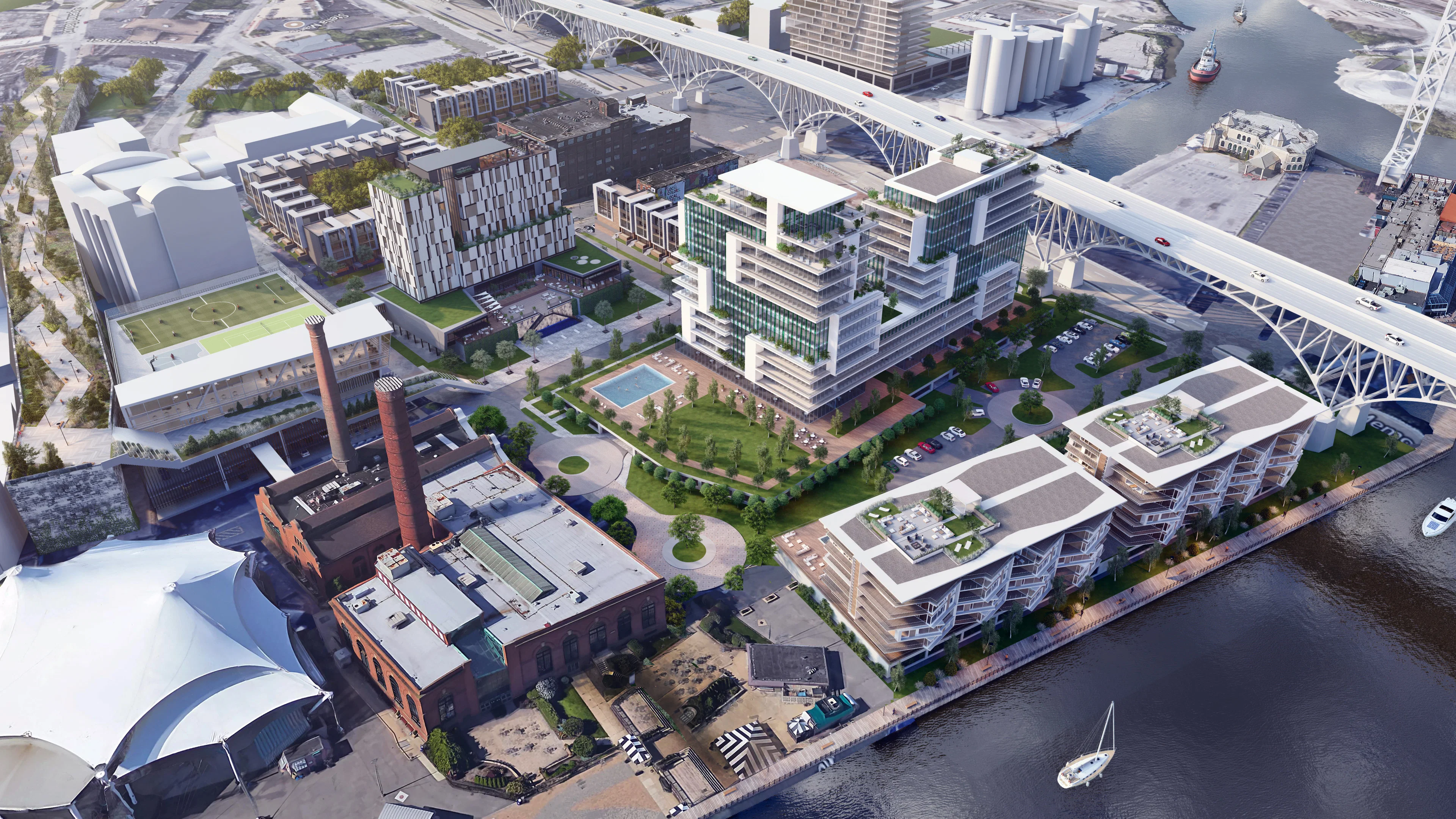
Flats West Bank, Cleveland centers on the Nautica entertainment district, a stretch of riverfront restaurants, bars, marina space, and an outdoor amphitheater built along the water's edge below Ohio City, Cleveland and Tremont, Cleveland. Unlike most of the near-west-side neighborhoods, it hosts an actual venue we work with directly, Windows on the River, making it one of the few locations on this list that is a genuine destination rather than purely a staging origin.
Programs that touch Flats West Bank, Cleveland typically fall into two planning groups: events actually held at Windows on the River or elsewhere in Nautica, and crew or freight staging that uses the district's proximity to downtown across the river and the hillside neighborhoods above it.
This page covers how we plan events at Windows on the River specifically, along with the broader logistics of using Flats West Bank, Cleveland as a staging point for downtown-bound or hillside-bound programs.
Flats West Bank, Cleveland, OH execution priorities
- Event production at Windows on the River, the district's anchor venue
- Riverfront marina and amphitheater logistics for outdoor programming
- Freight and crew routing between Flats West Bank, Cleveland and downtown across the river
- Coordination with Tremont, Cleveland and Ohio City, Cleveland on the bluff above the district
- Delivery and load-in planning specific to Nautica's waterfront access
Windows on the River as an actual venue
Windows on the River sits directly in the Nautica district on the Flats' west bank, a riverfront event space with water views that we book for corporate dinners, receptions, product launches, and mid-size conference programming that wants a distinctive setting rather than a standard hotel ballroom or convention hall. It is the one true venue on this page, not a proxy for something downtown.
Because it is a smaller, single-venue space rather than a multi-hall convention center, planning for Windows on the River focuses on a single load-in door, a defined room capacity, and a tighter vendor coordination window than a program at the Huntington Convention Center of Cleveland would need. We treat it as its own production, sized appropriately rather than scaled down from a larger convention-center plan.
Nautica's marina and amphitheater programming
Beyond Windows on the River, the broader Nautica district includes marina space and an outdoor amphitheater that occasionally host larger public or semi-public programming, product launch environments, or sponsorship activation buildouts that want visibility along the riverfront rather than an enclosed hall.
Outdoor riverfront programming here comes with its own weather contingency planning, since Cleveland's river-valley microclimate can differ noticeably from downtown conditions just a few blocks away. We build weather holds and covered-space backups into any outdoor Nautica program as a standard part of the plan, not an afterthought.
Waterfront delivery and load-in access
Nautica's riverfront layout means deliveries and load-ins to Windows on the River and nearby venues use a different access pattern than a convention center's dock system, generally a service road along the water's edge with more limited turning space for larger trucks. We scout the actual load-in paths before committing a delivery schedule, since not every truck size that works at a downtown dock fits comfortably on Nautica's service roads.
For custom exhibit builds or large-format printing delivered to a Flats West Bank, Cleveland event, we typically stage the final approach with a smaller shuttle vehicle if the primary delivery truck is oversized for the district's tighter streets, adding a short transfer step rather than risking a truck that cannot maneuver into the actual loading area.
Routing between Flats West Bank, Cleveland and downtown
For programs that split their footprint between a Flats West Bank, Cleveland event and a downtown show, the crossing is short, generally a five- to ten-minute drive over the Detroit-Superior or Center Street bridges. We schedule crew and equipment transfers between the two locations during a gap in both schedules to avoid conflicting with either venue's own load-in or event hours.
This cross-river coordination comes up most often for evening receptions tied to a daytime downtown trade show, where a client wants to move a subset of branded elements from the exhibit hall to Windows on the River for an evening event rather than fabricating a second set from scratch.
The hillside connection to Tremont, Cleveland and Ohio City, Cleveland
Flats West Bank, Cleveland sits directly below Tremont, Cleveland's bluff and just south of Ohio City, Cleveland, and crews or vendors staging from either neighborhood can reach Nautica quickly via the connecting roads down the hill. We use this connection for programs that want lodging or fabrication support in Tremont, Cleveland or Ohio City, Cleveland while running the actual event at Windows on the River.
This arrangement works well because it keeps crew lodging away from the district's tighter footprint, which has less hotel inventory than downtown, while still giving quick access down to the venue for load-in, show hours, and teardown.
Freight timing for Nautica events
Because Windows on the River operates as a single-venue booking rather than a convention center with a dedicated freight dock, we coordinate delivery timing directly with the venue's own event calendar to avoid overlapping with another booking's load-out or a restaurant's own delivery schedule elsewhere in Nautica.
For drayage and material handling into a Flats West Bank, Cleveland event, we build a tighter, more specific delivery window than we would for a large convention hall, since the venue's smaller footprint means less flexibility to absorb a late or early truck without disrupting other activity in the district.
Event types that fit Flats West Bank, Cleveland
The programs that work best here are corporate dinners and receptions, product launches wanting a riverfront setting, mid-size conference sessions that fit Windows on the River's capacity, and evening events that complement a larger daytime program running downtown.
Flats West Bank, Cleveland is not the right fit for a large-scale trade show needing exhibit-hall square footage; those programs belong at the Huntington Convention Center of Cleveland or I-X Center instead, with Flats West Bank, Cleveland reserved for a smaller complementary event.
Show-site supervision at Windows on the River
We staff dedicated on-site supervision for any Windows on the River program, coordinating directly with the venue's own event and catering staff rather than treating it like a self-service convention-center booth space. This matters more here than at a large hall, since a single-venue booking has less redundancy if something goes wrong with load-in timing or vendor coordination.
This supervision covers the full event window, from the initial delivery through teardown, and includes direct coordination with the venue's in-house team on anything that touches shared infrastructure like the loading area or parking.
What we recommend for Flats West Bank, Cleveland events
For any program at Windows on the River or elsewhere in Nautica, we recommend confirming the venue's own event calendar and load-in rules early, since a single-venue riverfront booking has different constraints than a convention-center hall and less room to absorb a scheduling conflict.
For programs pairing a Flats West Bank, Cleveland event with a downtown show, we recommend planning the cross-river transfer as its own scheduled step with defined pickup and drop-off times, rather than leaving it to be worked out day-of.
About Flats West Bank, Cleveland, Cleveland, OH
Flats West Bank, Cleveland, Cleveland, OH is part of the Cleveland event market. Shows and meetings book here alongside the larger Cleveland calendar.
Flats West Bank, Cleveland, Cleveland, OH sits in the Riverfront area.
Trade show work in Flats West Bank, Cleveland, Cleveland, OH shares most of its structure with larger Cleveland projects. Where it diverges is in the nearby venue mix, freight routing, and local hotel block availability.
Cleveland trade show market
Exhibiting in Cleveland means working inside an established event ecosystem. The venues, the labor model, and the local production capacity all behave in predictable patterns.
Trade show weeks in Cleveland compress decisions. Dock windows are finite, rigging slots fill fast, and the labor calendar around a citywide conference runs hot. Exhibitors who treat planning as optional lose time they don't get back.
the market with roughly 24,000 hotel rooms across Northeast Ohio, about 5,000 rooms in 18 downtown hotels, 600 connected rooms at the convention-center campus, and roughly 3,000 rooms within five miles of Cleveland Hopkins International Airport.
Cleveland Hopkins International Airport reported more than 10 million annual passengers and 47 nonstop destinations, which materially supports exhibitor, crew, and attendee lift into the market — a useful reference point when sizing a project.
Music, culture, and lakefront brand events is one of the sectors that shapes the Cleveland calendar. The Rock Hall can still host 20-800-person events during construction and is building toward a larger 2,800-person event venue, while the lakefront museum corridor adds high-visibility brand-event options that are distinct from hotel inventory.
Cleveland convention venues and meeting properties
The building matters more than almost anything else in a trade show plan. A few Cleveland venues carry most of the calendar.
Across the Cleveland venue set, what changes between buildings are the labor model, the rigging approval path, the drayage setup, and the published move-in window. The plan has to match the specific building.
Cleveland Public Auditorium. Cleveland Public Auditorium is directly connected to the Huntington Convention Center.
Public Auditorium includes a 10,000-seat stadium-style auditorium.
Hilton Cleveland Downtown: the property is a 600-room Hilton connected to the downtown campus.
Hotel Cleveland is one of the anchors. Destination Cleveland’s winter 2025 meetings update says Hotel Cleveland reopened after a $90 million renovation.
Cleveland labor and venue services
Most of what goes wrong on a Cleveland install traces back to assumptions about labor. Staying inside the venue's published rules for the specific show prevents it.
The workable version of Cleveland labor planning is boring on purpose: read the manual, match the scope to its planning groups, order what the venue sells directly, and schedule everything else around its posted windows. Surprises almost always trace back to a step someone skipped.
At Huntington Convention Center of Cleveland, full-time employees of the exhibiting company or show management may set up computers, which is a narrow but important exception to more general labor assumptions.
Exclusive utility and venue-service vendors should be confirmed early so booth, AV, and internet scope does not drift. Arena, stadium, and museum projects should be planned as venue-led operating environments with their own approvals and access rules.
Scope in Flats West Bank, Cleveland, Cleveland, OH Cleveland, OH
A full engagement covers scope development, fabrication or rental, graphics, show services, logistics, and on-site execution from move-in through dismantle.
What shows up in most budgets: structure, graphics, AV, show-service orders through the venue, labor, freight, supervision days, and closeout. Individual projects layer or remove items based on scope.
A well-run project has few surprises on install day because the handoffs upstream were tight. A bad one has many, because they weren't.
Multi-show programs add asset management: storage, refurbishment, graphic swaps, and scheduled re-kitting so the booth rolls cleanly from Cleveland to the next city on the calendar.
Out of scope by default are show organizer fees, booth lease costs paid directly to the show, staff travel and per diems, and any custom software or data-capture tooling the client runs on its own stack. Those stay on the client side and plug into the project through coordination, not rebilling.
The process from start to finish
First step on any project is pinning down the show, the floor plan, the deadlines, and what success actually looks like. Everything downstream hinges on those answers.
Venue coordination comes next. That means pulling the current exhibitor manual, confirming dock and freight windows, submitting rigging approvals where needed, and placing utility orders against the building's published specs.
With venue details locked, production runs. Build, print, AV integration, rentals, and the show floor lead's playbook all come together in this phase.
The install phase has one owner on the floor. That person handles the labor calls, the graphics questions, the sequence adjustments, and the daily update.
During show hours, the booth functions as a live operating space. A booth supervisor manages repairs, sponsor requests, lead-capture issues, and any venue questions so client staff can focus on conversations.
After the show, strike runs against the venue's posted window, and a same-day debrief captures what held and what needs to change before the next date.
Budget and timeline
Pricing is driven by real line items: fabrication or rental, graphics, show services, labor, freight, and travel where it applies. Round numbers without that breakdown usually hide something.
The levers that matter: build path (custom, rental, or hybrid), footprint, venue service fees, graphics, freight, and supervision days. A 10x10 turnkey rental and a 30x50 custom island with a double deck are entirely different projects.
A clean schedule starts 4 to 5 months out for custom work and 2 to 3 months for rentals. Shorter lead times are workable but push rush premiums and limit material choices.
How project performance gets measured
A successful project in Cleveland looks like a booth that lands on time, passes venue inspection on the first walk, runs without incident through show hours, and ships out the same day it strikes.
Exhibitors who measure programs seriously track leads, floor-booked meetings, and post-show pipeline. The build and the install are upstream inputs to those KPIs.
Client teams sometimes want the booth to carry the pipeline on its own, but the best-performing programs treat the booth as a platform and put real operators on it. On-floor conversation discipline moves the KPIs more than any scenic decision.
The advantage of a local Cleveland team
Trade Show Services of Cleveland supports Cleveland exhibitors with a planning model that keeps design decisions, production details, and show-site responsibilities visible before move-in begins.
The difference shows up before the dock opens. A clear project owner can confirm what the building requires, what the show organizer controls, which tasks belong to house services, and which decisions need client approval before the schedule gets tight.
Over a multi-show calendar, the compound value is fewer surprises. The second install should inherit notes from the first, the third should inherit both, and the program should become easier to forecast as the year moves forward.
Questions about Flats West Bank, Cleveland, OH
Is Windows on the River an actual venue you work with?
Yes. It sits in the Nautica entertainment district on the Flats' west bank and is the one genuine venue location on this page, used for corporate dinners, receptions, product launches, and mid-size conference programming.
Can Flats West Bank, Cleveland host a large trade show?
No. Windows on the River and the broader Nautica district are sized for smaller, single-venue events. Large-scale trade shows needing exhibit-hall square footage belong at the Huntington Convention Center of Cleveland or I-X Center.
How does delivery access work at Windows on the River?
Through a riverfront service road with more limited turning space than a downtown loading dock. We scout the actual paths before scheduling and use a smaller shuttle vehicle for the final approach when a delivery truck is oversized for the district's streets.
How far is Flats West Bank, Cleveland from downtown venues?
A short five- to ten-minute drive over the Detroit-Superior or Center Street bridges. We schedule crew and equipment transfers between the two during a gap in both locations' event hours.
Can I stage crew lodging in Tremont, Cleveland or Ohio City, Cleveland for a Flats West Bank, Cleveland event?
Yes, and it works well since both neighborhoods sit directly above Nautica with a quick connecting paths down. This also avoids the district's limited hotel inventory compared with downtown.
Do outdoor Nautica events need a weather plan?
Yes. The river valley's microclimate can differ from downtown conditions nearby, so we build weather holds and covered-space backups into any outdoor marina or amphitheater program as standard practice.
Do you work at Rock & Roll Hall of Fame?
Yes. it can host events for 20 to 2,000 people on its host-an-event section. Projects at that building are planned against its specific floor rules.
How does labor work in Cleveland?
It runs venue by venue. At IATSE Local 27, it serves as a referral hall for many major theatres, arenas, and convention halls in Cleveland and specifically lists the Huntington Convention Center, Public Auditorium, and Rocket Arena among its venue and employer information. Other Cleveland venues have their own published rules, and the plan matches the specific building.
How much lead time is ideal?
Custom builds run best with 16 to 20 weeks of lead time. Rentals take 8 to 12 weeks. Work inside 4 weeks is possible but raises costs and narrows the options.
What information kicks off a project?
The show, the venue, the booth number, the dates, and a target budget range. From those, an initial scope and a realistic cost come back within a few days.
Who runs the booth on-site?
One named show-site lead runs the install, the show hours, and the strike. That person carries the floor plan and the punch list from crates to doors and reports up once a day.
Can the booth travel to the next city on our calendar?
Yes — builds are designed for modular reuse unless single-use scenic is specifically required. Same structure, swappable graphics, standard crates. Cleveland programs that roll to another city on the same calendar get handled end to end.
What happens if something breaks during show hours?
The show floor lead handles it. Minor repairs happen in place; anything larger gets sourced from the local fabricators or rerouted through the venue's service desk.