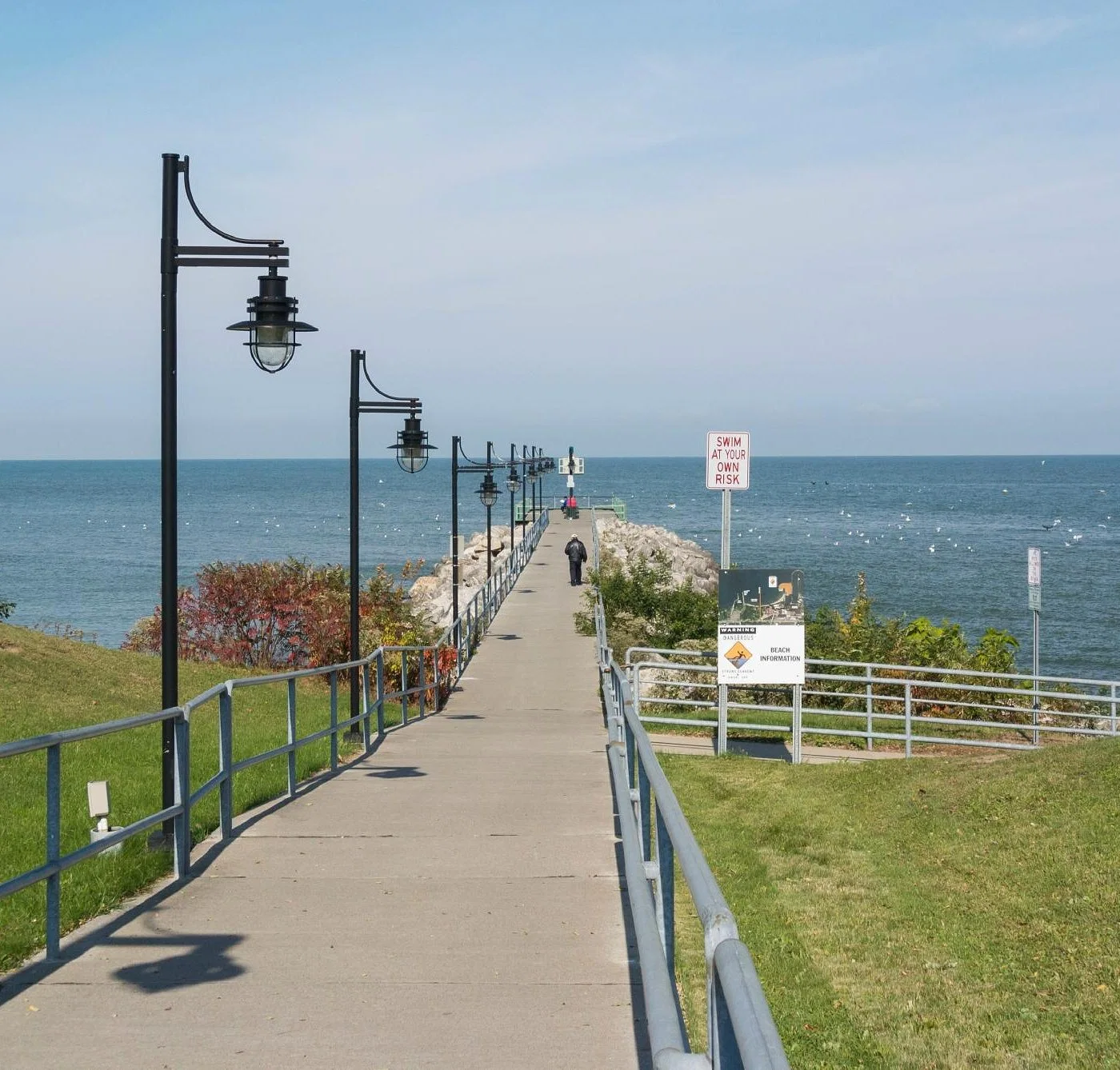
Avon Lake sits on Lake Erie at the western edge of our coverage area, a residential lakefront community with a smaller commercial base than neighboring Avon, centered on Lake Road and the industrial corridor near the power plant rather than a retail or office hub. Companies and organizations here are fewer in number than in Avon or Westlake, and most that exhibit regionally are manufacturing, energy, or smaller professional operations rather than large corporate headquarters. The town's identity leans residential and industrial rather than commercial, which shapes every logistics decision we make here.
The drive reflects that isolation. Avon Lake is roughly thirty-five minutes from Downtown Cleveland under normal conditions, the longest commute of any suburb in this network, and reaching even the I-X Center takes a genuine twenty-five to thirty minutes rather than the quicker hop available from Avon or Westlake. We plan every Avon Lake show around this full distance rather than rounding it down.
What Avon Lake lacks in commercial density it makes up for in straightforward logistics: light traffic, wide industrial-area loading access, and a lakefront setting with essentially no lake-effect competition for staging space, since there is little other commercial activity nearby to compete for it.
Avon Lake, OH execution priorities
- Thirty-five minute drive into downtown, the longest in the network
- Twenty-five to thirty minutes to the I-X Center
- Industrial-corridor loading access near Lake Road
- Manufacturing and energy sector client support
- Consolidated single-trip freight planning
Avon Lake's character and commercial base
Avon Lake is smaller and more residential than Avon, its neighbor to the east, with a commercial base centered on Lake Road and an industrial corridor near the lakefront power generation facility rather than a retail or office corridor. There is no equivalent to Avon Commons here, which means fewer exhibiting businesses overall and a client mix weighted toward manufacturing, energy, and smaller professional firms.
Because the exhibiting business base is smaller, Avon Lake shows are less frequent on our calendar than Avon or Westlake shows, but the ones we do handle tend to be industry-specific trade shows tied to manufacturing or energy sectors rather than general business conventions.
The honest distance from Avon Lake to Cleveland's venues
Avon Lake sits roughly thirty-five minutes from Downtown Cleveland via I-90 under normal conditions, the longest regular drive in our west-side coverage, and even the I-X Center, closer than downtown for every other suburb we cover, still takes twenty-five to thirty minutes from here. We do not shorten either estimate for clients; both numbers shape the schedule from the first call.
This distance means same-day booth changes or late graphics reprints carry real time cost from Avon Lake in a way they do not from Lakewood or even Westlake. We plan for fewer last-minute adjustments and more front-loaded preparation on Avon Lake-based shows as a result.
Industrial-corridor loading access
The industrial area near Lake Road, home to the lakefront power generation facility, includes loading and staging infrastructure suited to heavy freight, wide roads and truck-scale access built for industrial deliveries rather than retail or office traffic. We use this infrastructure when an Avon Lake build involves manufacturing-scale exhibit components or heavier equipment displays.
This is different in character from the retail loading we use in North Olmsted or the modern office docks in Avon; it is heavier-duty and less frequently used for exhibit freight, so we coordinate site access further in advance to make sure it is available on the actual build day.
Manufacturing and energy sector exhibitors
Avon Lake's manufacturing and energy-adjacent client base exhibits at industry-specific trade shows more often than general business conventions, frequently at the I-X Center given its scale and its history hosting manufacturing and trade expos. These shows often involve heavier or more technical exhibit components than a standard convention booth, sometimes including working equipment displays.
We adjust our crew composition for these shows accordingly, bringing in riggers or technicians experienced with heavier equipment rather than a standard booth-assembly crew, since the exhibit itself demands different handling.
Freight planning for the longest drive in the network
Given the thirty-five-minute drive to downtown and the twenty-five-to-thirty-minute drive to the I-X Center, we consolidate Avon Lake freight into as few trips as possible, planning the truck load carefully in advance rather than making incremental runs the way we might for a suburb closer to the core. Every additional trip from Avon Lake costs real time that a closer suburb would not.
For repeat manufacturing or energy clients, we keep reusable structural and equipment-display components stored locally, minimizing how often the heaviest pieces need to make the full drive at all.
Hotel and crew lodging for an Avon Lake-based show
Avon Lake has limited hotel inventory of its own, smaller than Avon's growing selection near the I-90 interchange, so out-of-town crew working an Avon Lake-based show typically lodge in Avon or Westlake rather than in Avon Lake itself, unless the show is a short single-day local event.
For downtown shows staged from an Avon Lake client, crew lodging almost always moves downtown entirely, since the thirty-five-minute commute is too long to sustain across a multi-day build.
Lakefront setting and staging space
Avon Lake's lakefront position means less competition for staging space than in a denser commercial suburb, since there is comparatively little other commercial or retail activity nearby drawing on the same loading infrastructure. This gives us more flexibility to hold a vehicle or stage a build over a longer window than we would attempt in a busier location.
That same lakefront position exposes Avon Lake to the same lake-effect winter weather that hits Lakewood and Rocky River, sometimes with less inland buffer given how far west and directly on the shore the community sits.
Seasonal planning for the far west end of the corridor
We treat Avon Lake as higher winter risk than Avon or Westlake, given its direct lakefront exposure, and build extra buffer time into any January or February build scheduled here. Combined with the already-long drive to Cleveland's venues, a winter storm affecting Avon Lake can meaningfully compress a build schedule if it is not planned for in advance.
Outside of winter, the primary scheduling consideration is simply the drive itself. We do not add much additional buffer for spring or fall traffic, since Avon Lake's distance from the urban core means it is less affected by downtown event congestion than the closer suburbs are.
How we plan an Avon Lake-based show
We start every Avon Lake plan by confirming the venue and calculating the real drive time, thirty-five minutes to downtown or twenty-five to thirty to the I-X Center, since neither is close enough to allow the same-day flexibility we build into a Lakewood or Rocky River schedule. Freight gets consolidated into as few trips as the show allows.
For manufacturing and energy clients specifically, we confirm equipment handling needs and crew specialization early, since these shows often require a different skill set than a standard convention booth build, and finding the right specialist takes longer than staffing a general install crew.
About Avon Lake, OH
Avon Lake, OH is part of the Cleveland event market. Shows and meetings book here alongside the larger Cleveland calendar.
Avon Lake, OH sits in the Far west suburbs area.
Trade show work in Avon Lake, OH shares most of its structure with larger Cleveland projects. Where it diverges is in the nearby venue mix, freight routing, and local hotel block availability.
What drives the Cleveland calendar
Cleveland runs one of the busiest trade show calendars in the region. Convention weeks stack close together, hotel blocks compete for the same nights, and the venues themselves shape what is possible on the floor.
The attendees vary by show — some weeks draw regional operators, others pull international buyers in for a single conference — but the floor mechanics stay consistent. Every booth needs graphics production, show services, labor calls, and a plan for the specific building it's landing in.
it is connected to the 600-room Hilton Cleveland Downtown and Cleveland Public Auditorium, giving downtown programs a genuine campus-style event core rather than a single isolated building.
the market with roughly 24,000 hotel rooms across Northeast Ohio, about 5,000 rooms in 18 downtown hotels, 600 connected rooms at the convention-center campus, and roughly 3,000 rooms within five miles of Cleveland Hopkins International Airport, which sets the practical ceiling for a booth program working the market.
Citywide conventions and association meetings is one of the sectors that shapes the Cleveland calendar. The Huntington Convention Center campus is large enough to support genuine convention and expo logistics, and the connected Hilton plus nearby downtown hotel stock make Cleveland workable for citywide programs rather than only one-off ballroom events.
The buildings that host Cleveland events
Different Cleveland venues mean different floor plans, different labor rules, and different freight realities.
Across the Cleveland venue set, what changes between buildings are the labor model, the rigging approval path, the drayage setup, and the published move-in window. The plan has to match the specific building.
Hilton Cleveland Downtown. The property is a 600-room Hilton connected to the downtown campus.
Hotel Cleveland: destination Cleveland’s winter 2025 meetings update says Hotel Cleveland reopened after a $90 million renovation.
How Cleveland floor operations work
Labor in Cleveland runs venue-by-venue, not citywide. Each building publishes its own rules for who handles what on the floor.
The workable version of Cleveland labor planning is boring on purpose: read the manual, match the scope to its planning groups, order what the venue sells directly, and schedule everything else around its posted windows. Surprises almost always trace back to a step someone skipped.
Huntington Convention Center of Cleveland — The convention center is a union facility and that certain union jurisdictions may apply based on the needs of the event.
Practical planning rules for Avon Lake, OH Cleveland, OH in Cleveland: At the Huntington Convention Center, certain union jurisdictions may apply depending on the event. Exclusive utility and venue-service vendors should be confirmed early so booth, AV, and internet scope does not drift.
What's included in the project scope
Project scope usually spans design, fabrication, graphics, AV, labor coordination, freight, install, show-hours support, and strike.
Typical line items include booth structure (custom or rental), graphics and print, AV and lighting, show-service orders (power, internet, rigging), labor calls against the venue's rules, freight both ways, on-site supervision, and post-show closeout documentation.
A well-run project has few surprises on install day because the handoffs upstream were tight. A bad one has many, because they weren't.
For programs that repeat, asset management becomes part of the engagement — storage, graphic rotation, refurbishment, and re-crating are planned rather than one-off.
A clean scope definition also calls out what isn't included: show organizer fees, client staff travel, and anything the client already has under contract (lead capture platforms, CRM integrations, promotional giveaways). Those run alongside the engagement rather than inside it.
How a project runs
First step on any project is pinning down the show, the floor plan, the deadlines, and what success actually looks like. Everything downstream hinges on those answers.
Once scope is clear, the venue work begins. Exhibitor manual, dock times, utility order IDs, rigging submissions for hanging elements, and labor calls all get locked against the venue's actual rules.
Production covers fabrication, graphics, AV spec, rentals, and crew chief assignment. It is the longest phase of most projects and the one where timelines are either protected or lost.
The install phase has one owner on the floor. That person handles the labor calls, the graphics questions, the sequence adjustments, and the daily update.
Show-hours coverage is part of every engagement — not a premium add-on. On-floor support keeps the booth running while the client team runs the pipeline.
Strike and closeout happen the same day. Storage labels, outbound manifests, vendor performance notes, and a written debrief go out within 24 hours of doors closing.
Pricing and scheduling
An honest quote itemizes the variables. There is not a single price — there is a configuration.
Six variables drive the cost: custom versus rental, booth footprint and complexity, venue-specific labor and rigging fees, graphics scope and substrate, freight distance and timing, and the number of on-site supervision days.
A clean schedule starts 4 to 5 months out for custom work and 2 to 3 months for rentals. Shorter lead times are workable but push rush premiums and limit material choices.
How project performance gets measured
A project runs well when install clears the venue's published window, all show services land as ordered, the booth performs across every show day without pulling the client team off pipeline work, and strike clears the dock before the next occupant loads in.
Most programs in Cleveland are evaluated on lead-capture volume, meetings booked on the floor, and qualified-pipeline attribution after the show. The booth is a means to those numbers — it is not the number itself.
Client teams sometimes want the booth to carry the pipeline on its own, but the best-performing programs treat the booth as a platform and put real operators on it. On-floor conversation discipline moves the KPIs more than any scenic decision.
What makes our work different
Trade Show Services of Cleveland supports Cleveland exhibitors with a planning model that keeps design decisions, production details, and show-site responsibilities visible before move-in begins.
Good execution depends on fewer blind handoffs. The person responsible for the plan should understand the room, the service orders, the graphics package, the install sequence, and the closeout path.
Consistency across show dates matters because many exhibitors reuse decisions, graphics, crates, and layouts across multiple venues. A documented plan helps the next event start from what was learned instead of starting over.
Questions about Avon Lake, OH
How far is Avon Lake from Downtown Cleveland and the I-X Center?
About thirty-five minutes to downtown via I-90, the longest regular drive in this network, and twenty-five to thirty minutes to the I-X Center, which is still the closer venue overall.
Do you support manufacturing or energy-sector exhibitors from Avon Lake?
Yes. Avon Lake's client base is weighted toward manufacturing and energy, and we bring in riggers or technicians experienced with heavier equipment for shows involving working equipment displays.
Can you access industrial-scale loading infrastructure near Lake Road?
We do, for builds involving manufacturing-scale components or heavier equipment. This infrastructure is used less frequently for exhibit freight than retail or office docks elsewhere, so we coordinate access further in advance.
Where does crew stay for an Avon Lake-based show?
Typically in Avon or Westlake rather than Avon Lake itself, given its limited hotel inventory. For downtown shows, crew lodging moves downtown entirely because of the longer commute.
How do you handle the long drive from Avon Lake for freight?
We consolidate into as few trips as possible and plan the truck load carefully in advance. Reusable structural and equipment components stay in local storage to minimize how often the heaviest pieces travel the full distance.
Is Avon Lake at higher winter weather risk than Avon or Westlake?
Yes. Its direct lakefront exposure puts it at greater risk from lake-effect snow, and combined with the long drive to Cleveland's venues, we build extra buffer time into any winter build scheduled here.
Do you work at Hyatt Regency Cleveland at The Arcade?
Yes. Hyatt maintains a dedicated special-events section for the property in The Arcade. Projects at that building are planned against its specific floor rules.
How does labor work in Cleveland?
It runs venue by venue. Huntington Convention Center of Cleveland: Edlen Electric handles electrical and plumbing services on an exclusive basis, and the exhibitor services portal covers electrical, plumbing, air, water, internet, booth cleaning, catering, and rigging. Other Cleveland venues have their own published rules, and the plan matches the specific building.
How much lead time is ideal?
Custom builds run best with 16 to 20 weeks of lead time. Rentals take 8 to 12 weeks. Work inside 4 weeks is possible but raises costs and narrows the options.
What information kicks off a project?
The show, the venue, the booth number, the dates, and a target budget range. From those, an initial scope and a realistic cost come back within a few days.
Who runs the booth on-site?
One named show-site lead runs the install, the show hours, and the strike. That person carries the floor plan and the punch list from crates to doors and reports up once a day.
Can the booth travel to the next city on our calendar?
Yes — builds are designed for modular reuse unless single-use scenic is specifically required. Same structure, swappable graphics, standard crates. Cleveland programs that roll to another city on the same calendar get handled end to end.
What happens if something breaks during show hours?
The show floor lead handles it. Minor repairs happen in place; anything larger gets sourced from the local fabricators or rerouted through the venue's service desk.